
Translation provided by the author
The Feminine Figure in the Archaic Romanian Culture
The feminine world is one that, throughout history, has been repeatedly oppressed, suppressed, misunderstood and reframed in accord with agendas that were far from its needs or even in their interest. Moreover, as the feminist movement keeps on bringing to surface aspects from the broad and still not very known history of women, we discover through their discoveries that in order to have a proper understanding of this world, we need to pay attention to not only mainstream or popular topics that are brought to surface, but to the deep, habitual and truly specific aspects that characterizes the womankind.
In archaic Romanian culture, the feminine figure maintained a profound relationship with the unseen world, relationship that has been persistently misread by later interpreters. What was often dismissed as superstition or social segregation was, in fact, a carefully bounded system of knowledge, made out certain gestures, rituals, and practices. These were not excluded from men, children or uninitiated women arbitrarily, but because they belonged to a specific threshold of experience that had to be reached beyond simple learning.
Understanding the feminine figure in the archaic Romanian culture cannot be detached from the knowledge system in which it operates. Romulus Vulcănescu defines mythogonias as „subjective stories of creative imagination that are in a permanent realistic-fantastic intuitive and explicative process of the world and life”, highlighting that, through their systematizations and classifications „the mythical logical steps emerged, and that they marked the first sparks of formal logic”. (Vulcănescu, p.222) Essential for the current thesis is that, within this logic, „the subjective reality that is dependent on imagination becomes the most common form of accessible immediate knowledge”. (Vulcănescu, p.222) This epistemological premise redefines the feminine knowledge status within the archaic space as an autonomous and coherent form of access to real, operating through innate mechanisms such is intuition, ritualic gesture or liminal mediation, that will not obey a discursive verification because of their given symbolic efficacy.
The Fates

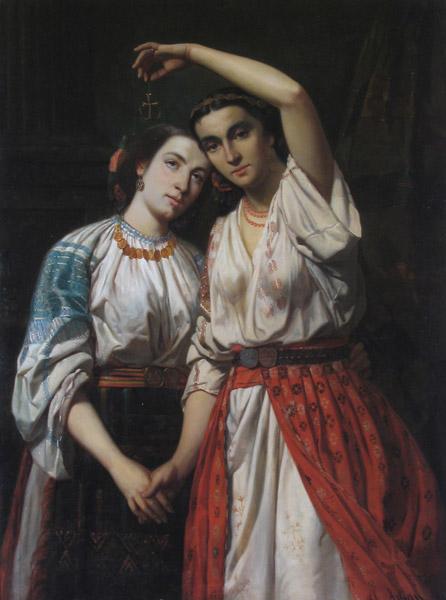
The first and the most structured of these mechanisms is destiny determination. Fate (with a plurality of other names in Romanian language) acts in the name of the demiurgical twins, and her direct representatives in the human dimension are The Fates. Vulcănescu notes that „during the apex of the agro-pastoral and then the separation of agriculture from shepherding, the role of woman in the household began to grow and, in parallel, her magical-mythical activity within the ethno-cultural community” (Vulcănescu, p.163), during this time the goddess Bendis imposing herself in the Thracian pantheon, with her corresponding to the Greek Artemis and the Roman Hecate. Her acolytes „start getting more defined attributes under their role rapport in the determination of fate” (Vulcănescu, p. 163). The Fates embody themselves as a triad made of The Spinner, The Untangler and The Reaper, three Virgin-Girls or Hags-Virgins that have a perfect functional parallelism with the feminine triad of Hecate (Vulcănescu, p. 164). Their virginity is not a simple biographical characteristic, but an ontological condition, because „the state of physical and spiritual purity is strictly needed for the rite of foretelling and its impartiality” (Vulcănescu, p. 164). In the third night after birth, The Fates produce a synthetical prospection of the whole life of the newborn, after which The Reaper „takes the yarn ball and hides it in a mountain cave where only The Fate has access” (Vulcănescu, p. 164).
This act is associated with a whole ritual of welcoming: in the newborn’s room the parents set up a big table with special food and drinks to welcome The Fates, so they can feast as they wish, for their kindness to reveal when prospecting the baby’s life. The structure of this gesture reveals their status not as exterior oracles, but as forces that cannot be refused, and that have irrevocable determinations that the community tries to negotiate ceremonially, not rationally.
The Liminal Earth-Mother
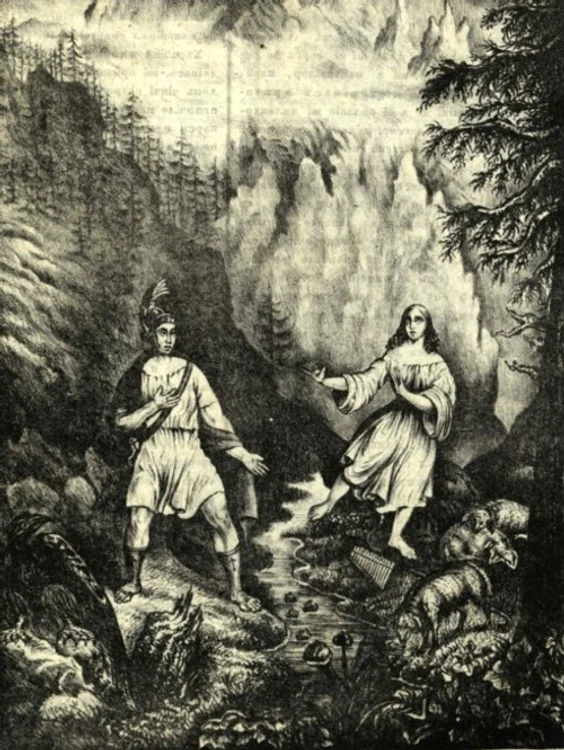

The logic of the threshold that The Fates embody, as they are present exactly at the border of non-being and being, is present in an amplified cosmic form in the image of Baba Dochia. Vulcănescu analyses the two sequences of her legend as revelatory for their „ethnogonic character” (Vulcănescu, p.268). In the first instance, the Dacian princess transforms herself in an old she-shepherd through a prayer at Zalmoxis, operating a voluntary passing from a state to the other in order to escape the Roman Empire chase. In the second instance, Dochia is turned into stone among with her 20 sheep because she defied the meteorological god and his powers. From both stories we must notice the structure of the metamorphoses that the woman undergoes, because she doesn’t die nor lives in the common sense, but enters the stone order, meaning permanency, getting past the opposition between life and death through her conversion. She becomes a purely liminal figure, at the border between young and old, mother and daughter, princess and shepherd, but nonetheless, a woman.
This relationship between femininity and earth as primordial matter is explicitly articulated in the cult of Mother Earth, which survival in the popular Romanian practices is documented by Romulus Vulcănescu through some ritualic gestures of a remarkable clarity. According to a manuscript of I. Pop Reteganul quoted by Vulcănescu, „when birthing hour comes, the future mother is laid down, so that the earth, as mother of all, receives the newborn first”. The author mentions that „This rite of giving birth on the ground is a human offering given to the Great Tellurian Goddess” (Vulcănescu, p. 446). Furthermore, the ethnological research identified the same principle in wedding and death rituals, with the newlyweds mating on the ground, so that their union will be „everlasting, as the earth”, and laying the dying person on the ground so that death will come easy. These are three rites of one and the same cult of the earth. Femininity is not, in this cosmology, an isolated biological propriety, but rather the human analog of the tellurian principle as a receptacle of life and mediator of passings. The legends of The Old Mother, analyzed as a surviving artifact of The Mother Earth recodified according to Christianity, confirms the existence of this structure through chants that are invoked in the name of the Mother of God, in the same way in which the Mother Earth was invoked by Dace-Romans medics and warlocks.
Ielele

If the figures analyzed so far operate inside the community order by determining destinies, passing thresholds or receiving offerings, Ielele represent femineity that went out of this order and entered the one of forces. Vulcănescu defines them as „fairies of the sky, forests and fields that personify atmospherically states of air that is continuously moving and changing.” (Vulcănescu, p. 428). He suggests that their origin admits an „unconcordant polygenesis, the four main stories behind their origin being heterogenous. Independent of their origin, their behavior remains consistent, „they always gather at night, during moon, in clearings, glades or under trees or in blooming fields or swamps, at crossroads or infested places.” (Vulcănescu, p.428-429). Their semantical polyvalency is so big that their own name is a taboo, and pronouncing their true name brings functional muteness. This reveals an exceptional polysemy and polyvalency, as the author says. From my study perspective, what defines Ielele as a structural figure is the relationship between femininity and forbidden knowledge. They know or are something that the social order cannot either name or dominate, so they are circumscribed through taboos, tamed through euphemism and kept at bay by rite. A proof of this is that the Old Hags-Iele turn ugly and kill those who refuse their flirt, meaning that the ignored feminine knowledge doesn’t disappear, but comes back as a perturbance of the order that they refused to support.
The Collective Mythical Fond
The analytical crossings of these figures reveal a coherent and repetitive structure that proves that in the archaic Romanian mythology, the access to the profound knowledge of the world is systemically reserved to some feminine figures that operate in conditions of liminality such as nighttime or thresholds, which are states that are excepted from the current social order. This recurrency is not occasional and cannot be reduced to a simple gender segregation. This indicates an organizing principle of the folklorical Romanian cosmology, where certain forms of knowledge cannot be accessed from inside the diurnal, rational and social order, but from a marginal position, of passing, of suspended normal state. And this position is, structurally, the one occupied by the archaic Romanian woman in her defining moments, while giving birth, at the wedding or dying, or in the night of the foretelling, in the woods or at crossroads. At the same time, The Fates work on the third night, at the border between non-being and being, Dochia passes cosmic thresholds in moments of extreme crisis, The Old Mother receives human offerings at the moment of birth and Ielele roam freely during the witching hour, having uncontrolled access to the human world. In all of these cases, the woman is the channel through which a pre-individual knowledge, trans generationally accumulated in the collective mythical fond becomes operative in the concrete world.
This very structure makes intelligible her relationship with weaving, especially with the weaving of the ia. If the analyzed figures above represent moments of maximum intensity of feminine mediation, the weaving represents the mundane form, sedimented and ritualized into the repeated gesture. Considering that „the subjective reality that is dependent on imagination becomes the most common form of accessible immediate knowledge” (Vulcănescu, p.222), ia goes beyond the crafting product of the artisan-woman towards a visual archive of archaic feminine knowledge, one of the few documents that survived.
This means that in order to fully understand it, a classical and quite simple semiotic lecture of ia would reduce the very things that make it unique: the density of their plural semantics, and their capacity of condensing irreconcilable meanings in the same visual form, exactly in the way in which oneirically imagery condense, in the Freudian way, contents that otherwise in the wake state would mutually exclude themselves. The rhomboid is not either uterus, either field, either eye, either cosmos, but all these simultaneously, and this simultaneity makes it capable of functioning as archetypal imagery in the Jungian acception, meaning activating in the ones that receives or wears it layers of meaning that are not accessible through discourse. The weaver woman does not invent or elect it, but it reproduces it from a memory that precedes her individual consciousness and that is shared with the same collective mythical fond were fantastical creatures’ origin from and use it as well for foretelling or aprioric knowledge.

This continuity between the mythical feminine figures and the mundane gesture of weaving goes further, if we consider that women wove in certain days, and that patterns were transmitted from mother to daughter especially through mimesis, and that a certain economy of the ritual had to be kept. All these traits prove that the imagery fond could not be always accessed, meaning that it had a particular time when it could have been done, circumscribing this activity in the regime of liminal knowledge that we described above. In this way, weaving was similar to daydreaming, an act through which the women body was in a state of ritual concentration that enabled her to be a channel for the collective pre-individual knowledge could be brought to surface and fixed on cloths.
Border permeabilization
The archaic Romanian woman occupied the structural position of a mediator between worlds by preparing herself bodily and spiritually through rituals, with systematical practices of border permeabilization. Elena Niculiță-Voronca documented a whole arsenal of techniques through which the girl or the woman was deliberately inducing the contact state with the invisible, and their vast majority happened at the same specific moment, at night, at midnight, or right before a sacred time. „Around Christmas, in Mihalcea, at midnight, the young girl places the shirt on the door, runs three times around the house, and at the third time, she will see her destined lover.” (Voronca, p. 107). The woman enters a maximum liminal state exactly through giving up on everything that defines her in the diurnal order. She is unveiled, without the social covering of clothing, doing circular movements around the domestic space, at midnight. The shirt put on the door marks the threshold, it being now exposed between interior and exterior, seen and unseen, working as a material interface that invites the future lover to materialize. In Broscăuți the same principle appears in another form, where the girls put the clothes on the table before sleeping in order to dream their destiny lover. (Voronca, p. 107) In Botoșani, the girl sow’s hemp seeds at the bottom of a tree and plows while chanting „I do not sow hemp for the shirt’s cloth, because I have it, but I sew the way for the destiny lover, in dream to dream it and in reality to see it.” (Voronca, p. 65). The shirt, meaning the raw material or the ia itself, is the very instrument through which the feminine body articulates with the invisible. Ia prepares the passing, marks the threshold and materializes the wish of seeing what, in the normal way of things, should remain hidden.
This interface function of the Romanian traditional blouse can’t be separated from the ritual economy of the gesture that produces it. Niculiță-Voronca systematically documents the interdictions that revolved around the act of sewing and spinning the thread, and their internal logic is consistent, because the creative textile gesture was reserved for specific periods of time, and transgressing these limits attracted consequences that were not simple social punishments, but disruptions of the cosmic order. „On Fridays you must not sew or spin the threads” (Voronca, p. 230) the reason being that „put the distaff in a closet, so you won’t see it, neither the distaff, nor the needle (…) as long as the holidays are, and during this time the distaff should not stay in the house, and no one should spin the thread, because not even Virgin Mary did.” (Voronca, p. 64).
This justification shows the assimilation of the feminine gesture with an act of sacred nature, that must follow a rhythm similar with the divine. Sewing or spinning the thread at the wrong time meant entering in contact with the powers of the clothing without the protective framework of the ritual time, with unpredictable consequences. The most direct confirmation of this logic comes from a personal story of the author, that relates the fact that „at Saint Andrew’s Day, author’s mom, being a child, hid and sew a sock on her leg. But it sewn tight (it is said that during Sundays and holidays, if you saw something, you need to sew it quite lightly, so it won’t hold that much time, only during the sacred time), and it got twinges in her leg. She had to stay in bed for 3 months.” (Voronca, p. 490). The detail regarding the strength of the sewing reveals an understanding of threading as act that has effects according to the temporal context in which in happens. During sacred times doesn’t hold, and during forbidden times can attract physical repercussions. There is, in other words, a direct correspondence between the moment of the gesture and the nature of the produced matter, which implies that the sewn motifs are impregnated with time and mood attributes from the moment they are done.

Ia as active and sensitive recipient

This understanding of cloth production as a strictly regulated temporal act articulates directly with the logic of the imaginary that Gilbert Durand analyses in The Anthropological Structures of the Imaginary. Durand observes two fundamental regimes of the image: The Diurnal Regime and The Nocturnal Regime, both dependent on their attitude towards time and antithesis. Durand identifies in the structure of the Nocturnal Regime of the image a fundamental movement of reversing the diurnal values, where instead of finding a fight against darkness and time through images of ascension and light, the Nocturnal Regime assimilates, euphemizes and transforms them into a substance of intimacy and continuity.
This „reversing of the values of darkness attributed to night by the Diurnal Regime” (Durand, p. 216-217) is not a simple reverse movement, but an active operation of recovering what the diurnal order refuses. This very logic of the nocturnal reversing operates in the sewing gesture and in the ritualistic dimension of the ia, which we previously described, where the woman doesn’t produce an object outside the diurnal time, but it produces it from the ritualized night, from the liminal time carefully chosen. The motifs that she is sewing on the cloth carry qualities of that specific time, that the diurnal mind cannot name nor reproduce. The interdictions documented by Elena Niculiță-Voronca are validations of the fact that the sewing gesture operates in the Nocturnal Regime of the imaginary, and that it is sensitive to the temporal context in which it is made and that the access to the image fond that it mobilizes is not available at all times, and in any way.
For Durand, the central symbol of this nocturnal world is the recipient. Going from the intimacy symbols to those of cyclical temporality, Durand observes that „the most radical attitude of the Nocturnal Regime of imagery is immersing into a substantial intimacy”, that halving and embedding are just „prefiguration in space of the fundamental ambition” of time dominion, and that „the archetypal symbol is the general recipient, the cup, that is overdetermined herself by the reveries of the content” (Durand, p. 283). Ia is, in this logic, a textile recipient, that contains in its visual structure the fond of images that the women accessed in her liminal creative state. Vulcănescu confirms this recipient function when he shows that mythogonias work through the fact that „the subjective reality that is dependent on imagination becomes the most common form of accessible immediate knowledge” (Vulcănescu, p. 222). Ia is the recipient in which this immediate knowledge, accessed in the liminal state, is fixed and survives passing over. The prohibitions documented by Niculiță-Voronca (to leave needles stuck, to leave work unfinished, to let the distaff in the pantry for the holidays) treat the traditional Romanian blouse as an object that retains something and that, if wrongly manipulated, can release what it accumulated because of the non-compliance. Ia is an active and sensitive recipient of the conditions of its production and wearing.
The Nocturnal Regime of the imaginary is articulated, in Durand’s theoretical system, around the dominion of time through cyclical symbols. The symbols that constitute this constellation „are grouped in two categories that follow the way in which we put the accent either on the power of infinite repetition of the temporal rhythms and the cyclical dominion of being, or on its role” (Durand, p. 283-284) of progressive dramatization. The rhomb and the spiral motifs found on ia’s work exactly as the first category, repeating themselves infinitely, reproducing in the textile material the same pattern through which the nocturnal imaginary resists against the linear time. The moon, which is a central symbol in the Nocturnal Regime, „is at the same time measure of time and the explicit figure of the eternal return”, and what we learn from all the lunar themes „is a rhythmical vision of the world, rhythm realized through the succession of contraries, through the alternance of the antithetic modalities” (Durand, p. 294). This very rhythmic vision, opposed to a fixed image, is the one that fixates all the repetitive motifs on the ia.
The sun sewn on the chest of the beholder is not the static sun that it depicts, but the cyclical sun that always comes back, the solstitium that returns, the never-ending cycle. And placing the motifs on the body also confirm the Durandian observation about centrality as a property of the sacred space: „the notion of sacred space implies the idea of primordial repetition that consecrates this space through its transfiguration” (Durand, p.242). The women who wear a solar motif sewn exactly on her chest sacralizes her body, constituting it as a space of primordial repetition, as a center around which the cosmic order organizes itself.

If Durand gives us the theoretical structure of these images, Elena Niculiță-Voronca offers their living corresponding in the popular Romanian belief. The author writes down that dream was perceived as a bidirectional channel between the seen and the unseen world. „Days appear to you through dreams, and they tell you what to do in a time of need, of disease, or anything. They show you through dreams which one to keep, and if it doesn’t suit you, they reveal themselves right away, as you go about your work, that something will happen to you.” (Voronca, p. 28). And dreams were very well differentiated: „At night when we sleep, the good dreams come from the angel, the angel whispers them in our ear, and the bad ones from the evil (the unclean), he whispers those.” (Voronca, p. 425). This distinction is an ontology of the dream which Durand describes in structural terms, because during sleep state, the human body becomes permeable to forces that go beyond him and that transmit knowledge that the diurnal mind cannot receive. What Durand calls „a reversing of the values of darkness” through entering the Nocturnal Regime is what the Romanian popular belief codifies in the terms of the permeability of sleep towards angels, demons and other cosmic powers. The two systems describe the same phenomenon from complementary angles that give it both architecture and life.
What Vulcănescu adds to this equation is the dimension of transgenerational transmission. If, in the popular belief documented by Elena Niculiță-Voronca, ia was the instrument through which the destined lover materialized in dreams, and if Durand shows that the archetypal symbol of the Nocturnal Regime is the recipient as a form of intimacy that preserves, then the motifs sewn on the ia must be understood as product of a double gesture: one that accesses those images from a collective fond of images during the creative liminal state, and one that fixates those images into a textile, transmissible recipient. This knowledge (Vulcănescu, p. 222) is passed on through object, through the traditional Romanian blouse as recipient of the feminine imaginary, sewn during a ritual time, wore on a body that repeats the cosmic gesture of centering, passed on from mother to daughter as a living image. Considering that the models were transmitted through mimesis, that there were interdictions and prohibitions that states days when sewing was allowed and when was forbidden, that unfinished work could not be left like that with the needles stuck in the cloth, all of these are indicators for the fact that the sewing gesture was perceived, in the cultural archaic world as belonging to the same regime of liminal knowledge that reserved the woman access to The Fates, to the nocturnal figures of the cosmology and to the forces that the diurnal order could not name nor dominate. Ia is the material proof that this knowledge existed, and is maybe, the only document that survived.
Conclusions
My aim was to demonstrate that the Romanian traditional blouse, ia, cannot be understood exhaustively as ethnographic object, neither national identitary symbol nor product of the feminine craftsmanship without losing what makes it so specific: its status of recipient of a knowledge that precedes and goes beyond the individual that creates or wears it. The argument was built in three consecutive moves, each one of it adding an additional layer of intelligibility to the same central hypothesis, that the woman that sews and the woman that dreams are, in the archaic Romanian culture, manifestations of the same structural role, and ia is the material proof of this identity.
The first move established that the access to the profound knowledge of the world is reserved, in the popular Romanian cosmology, to some feminine figures that operate in conditions of liminality, usually at night, at thresholds and other states excepted from the current social order. The Fates, Baba Dochia, The Old Mother or Ielele do not constitute an heterogeneous gallery of folklorical mythological characters, but they articulate a coherent organizing principle: the archaic Romanian femininity is structurally associated with moments of maximum permeability between world, with passings that the diurnal order couldn’t administer and with knowledge that the rational mind could not comprehend. Romulus Vulcănescu documents this structure consequently, and its lecture through the mythological grid offers it an epistemological coherence that, normally, a reducing to superstition or a gender segregation would systematically refuse.
The second move showed that this liminal position was ritualistically and bodily prepared through systematical practices of borders permeabilization. Elena Niculiță-Voronca documents the whole arsenal of techniques, from the ia put on the door at midnight, the clothes left on the table before sleep to the hemp sewn with ritual sayings, through which the women deliberately induced a state of contact with the invisible. Decisive for our argument is that in all of these examples, the ia itself worked as a material interface between seen and unseen, as a material threshold that invited the unseen forces to materialize. This interface function is not to be separated from the ritual economy of the gesture that produces the clothing, considering that interdictions regarding sewing in forbidden day, leaving needles stuck or spinning the thread during holidays treat ia as an active recipient, sensitive to the conditions of its production and wearing, capable of retaining or liberating what it has accumulated according to the rightful ritualistic doing of the creative gesture.
The third move put in dialogue this folkloric logic with the theoretical framework of Gilbert Durand, showing that the two systems, the structural and the ethnographic one, describe the same phenomenon from complementary angles. The Nocturnal Regime of imaginary, with the diurnal values reversing, the recipient as archetypal symbol of substantial intimacy and its cyclical structure that resists the linear time, offers the theoretical architecture through which the motifs on the ia become intelligible beyond their descriptive semiotic lecture. The rhomb, the spiral or the solar motif do not represent the world, but it condenses it, in the way in which the oneirical images condense irreconcilable contents in a single visual form. The woman that sews will not invent or pick them, but reproduce them from a memory that precedes her individual consciousness and that has the source in the same collective mythical fond that The Fates access in the third night after a child is born, or that Ielele wear in their nocturnal flight.
What results from this triple convergence is a methodological proposal with larger implications than the study of the ia itself. If the patrimony objects can function as recipients of the collective nocturnal imaginary, then their proper lecture cannot be exclusively semiotic, ethnographic or historical, as this lecture needs to be archetypological, in the way in which Durand understands it: a lecture that is capable of recognizing in the visual structure of an object a way of pre-individual knowledge, physically and ritualistically transmitted, accessible not through analysis, but through participation. Ia is a threshold that needs to be crossed, exactly in the way in which the archaic Romanian woman passed the border between the worlds during the ritualic nights, ready to receive what sleep and the liminal state will bring.
The question that remains open, and that may constitute the most productive bet of this study for future research is to what extent does this logic survive today. The contemporary recovery of ia, from The International Ia Day to its fashion adaptations and its presence online, redistributes the object without redistributing the knowledge regime that produced it in the first place. When motifs are industrially reproduced, when the sewing gesture disappears or becomes decorative, when the wearer is unaware of what she is weaning, is not only tradition that gets lost, but a way of being in the world, where the border between the seen and the unseen was permeable, in which knowledge was not proved but enforced, and in which the feminine body was not an object for the eye, but a channel of the world. This loose cannot be recuperated through cultural revival or through identitary revaluing, but just through a turning back to the logic that the ia carries in its visual structure, a nocturnal, cyclical, pre-individual logic that survived because it decided to hide where the diurnal order would not look. In the thread sewn by the woman hand in the ritualic night, on the cloth that veils the body that repeats, without knowing, the cosmic gesture of centering.
References:
- Durand, Gilbert, Structurile antropologice ale imaginarului, București, Editura Univers, 1977
- Niculiță-Voronca, Elena, Datinele și credințele poporului român, Vol. I, București, Editura Polirom, 1998
- Vulcănescu, Romulus, Mitologie română, București, Editura Academiei Republicii Socialiste România, 1987
Bibliography:
- Bachelard, Gaston, Poetica spațiului, București, Editura Paralela 45, 2003
- Durand, Gilbert, Structurile antropologice ale imaginarului, București, Editura Univers, 1977
- Freud, Sigmund, Interpretarea viselor, București, Editura Trei, 2010
- Jung, Carl Gustav, Arhetipurile și inconștientul colectiv, București, Editura Trei, 1994
- Jung, Carl Gustav, Omul și simbolurile sale, București, Editura Enciclopedică, 1994
- Niculiță-Voronca, Elena, Datinele și credințele poporului român, Vol. I, București, Editura Polirom, 1998
- Vulcănescu, Romulus, Mitologie română, București, Editura Academiei Republicii Socialiste România, 1987

Lasă un comentariu