
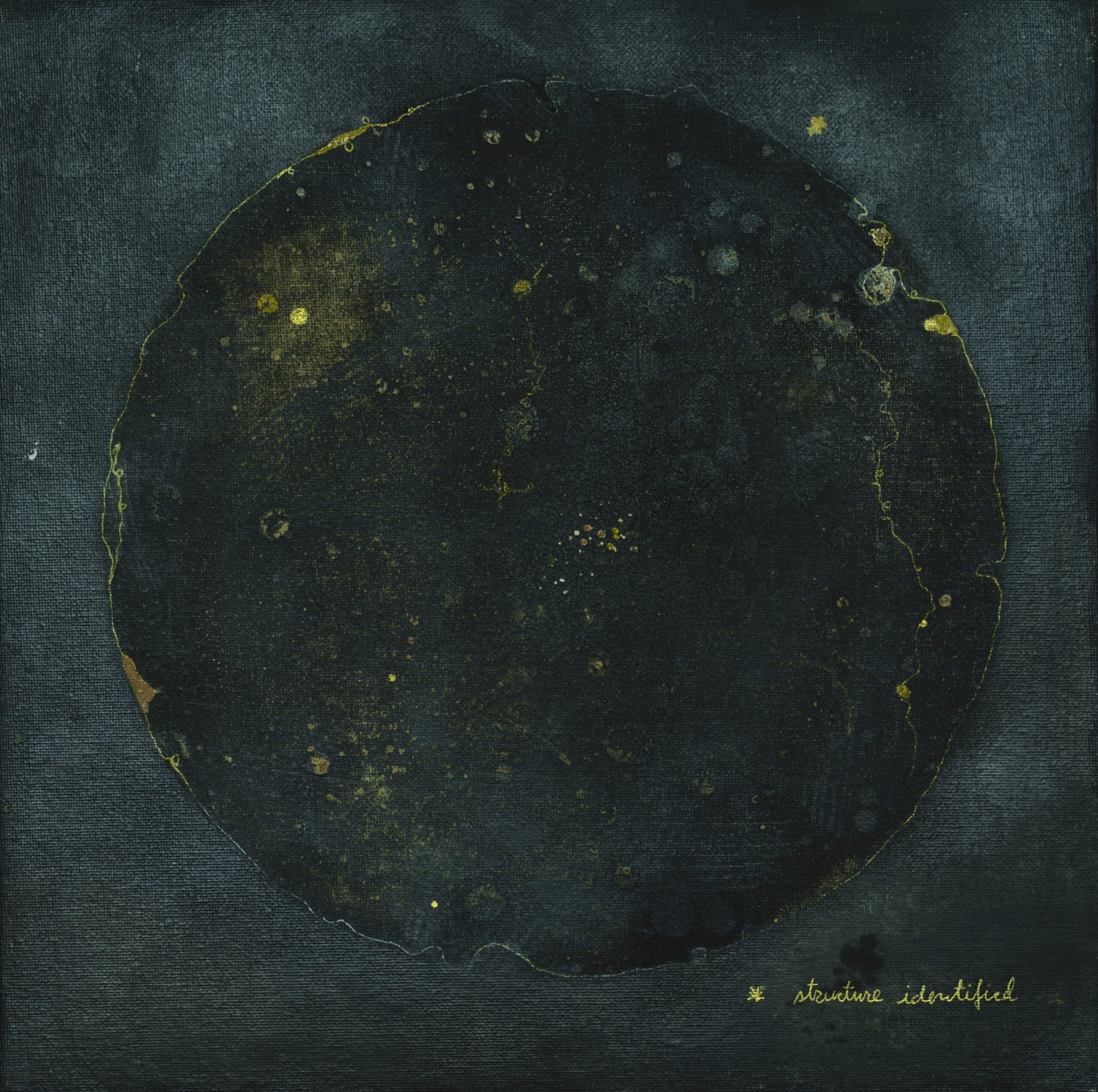
Roxana Donaldson is a Romanian artist whose practice is grounded in sustained artistic research, initially oriented toward the vegetal world and gradually extending into adjacent territories of affect, memory, and corporeality. Her work is defined less by the medium, and more by the process. Each piece emerges through a sequence of deliberate procedures, where material handling becomes inseparable from conceptual articulation. Roxana frequently works on bed sheets, a support that carries domestic, bodily, and intimate connotations. Through repeated interventions, layering, erasure, and transformation, the fabric shifts from a passive surface into an active field of inquiry. The process itself retains a ritual dimension. As the artist has noted, the final act of ironing the works is not merely technical, but affective, producing a sense of warmth and care that becomes integral to the work’s internal logic.
The interview with the artist after the opening is available here.
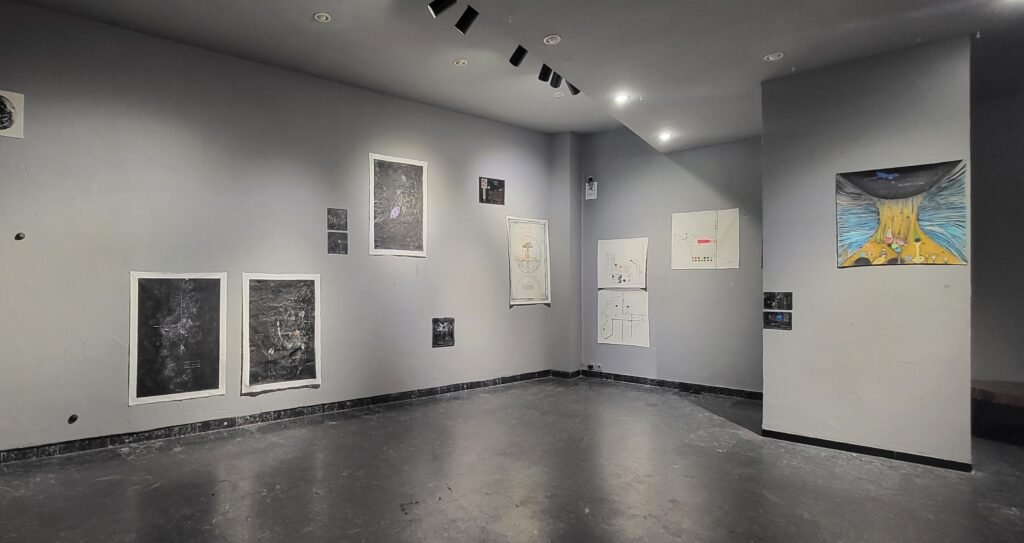
In Safety First – The Aftermath, which took place between 19.11.2025-30.11.2025 at Calea Victoriei Gallery 91-93, Roxana brings this practice to Bucharest and reconfigures the installation as a renewed inquiry into interiority. The exhibition, curated by Ph.D. Silvia Stoica, departs from personal exploration, yet deliberately opens toward the viewer, proposing a shared space of reflection rather than a closed narrative. What is offered is an invitation to enter the work’s affective structures and to trace one’s own pathways through them. First time exhibited at Dalgart, this time the exhibition changes, as it is composed of modular and reconfigurable objects and paintings, that have the special property of changing each time a new space gets inhabited (or maybe conquered? infected even?) by it.
The curator, Silvia Stoica, managed to give great value to the artworks through her curatorial approach, the final aesthetic being one open to the viewer, inviting, and at the same time sufficiently powerful to tell its own story. To be more precise, the dialogue between the viewer and the exhibition feels real, both parties having a voice and having the power to enter a connection that gives the artworks new meanings. Her vision managed to find balance without losing momentum, at the end of the visit the aftertaste being one in which you want to see more, so you start the visit again – and you discover new layers of understanding that fulffil – for the moment – your cravings.
In this sense, Safety First – The Aftermath can be read as an investigation of pathology understood not as deviation, but as epistemic terrain. Pathology, derived from pathos and logos, becomes a way of articulating those zones where affect exceeds regulation, where emotion resists instrumentalization. Roxana’s installation operates precisely within this interval, transforming fear, vulnerability, and defensive structures into legible forms of knowledge.
Imperfect X-ray of a Butterfly Helping a Human Breath
In the artwork Imperfect X-ray of a Butterfly Helping a Human Breath, the stratified visual structure closely mirrors the layers of meaning the viewer is invited to navigate. The image presents itself as a partial, unstable radiography: in the central-left area, the contours of a ribcage emerge, overlaid by the violet outline of a butterfly. This superposition establishes a fragile dialogue between interior anatomy and exterior presence, between what sustains life and what appears weightless, almost incidental. The work plays deliberately with perception. Forms shift between recognition and dissolution, forcing the eye to adjust continuously, as if the act of seeing were itself imperfect. In this sense, the title functions less as a descriptive label and more as an interpretive key. It frames the image not as a literal representation, but as a speculative diagram of interdependence.
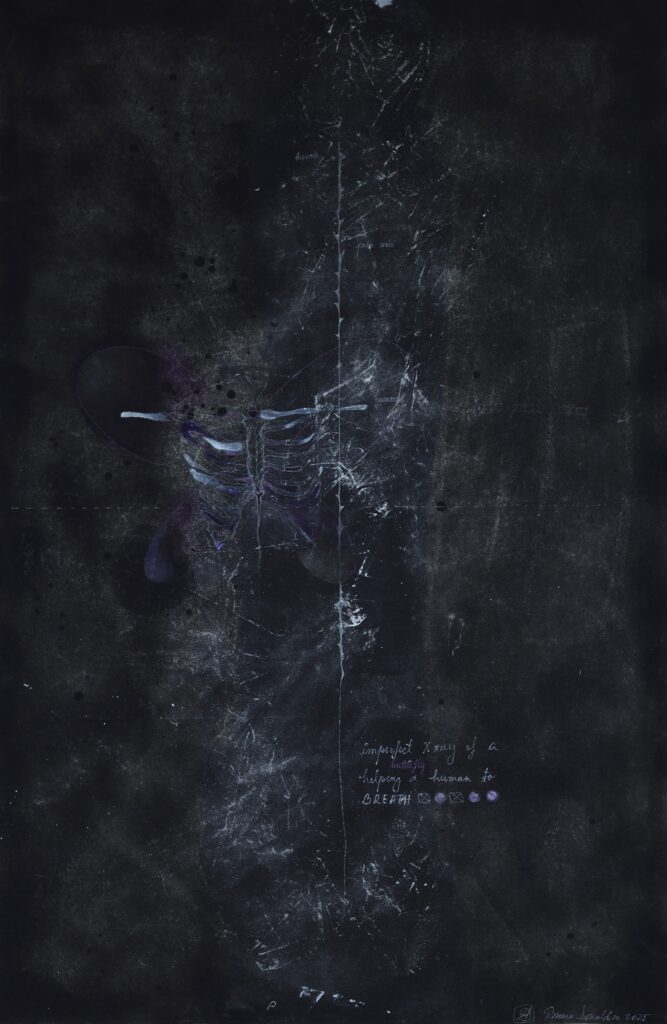
The butterfly’s gesture of “help” is not heroic or interventionist. Its efficacy lies precisely in its apparent insufficiency. Light, fragile, and nearly immaterial, it operates as a counterpoint to the density of the human body. Breathing here is not assisted through force or structure, but through presence, balance, and minimal contact. The work thus reverses conventional hierarchies of support, suggesting that what sustains us may come from what seems least substantial.
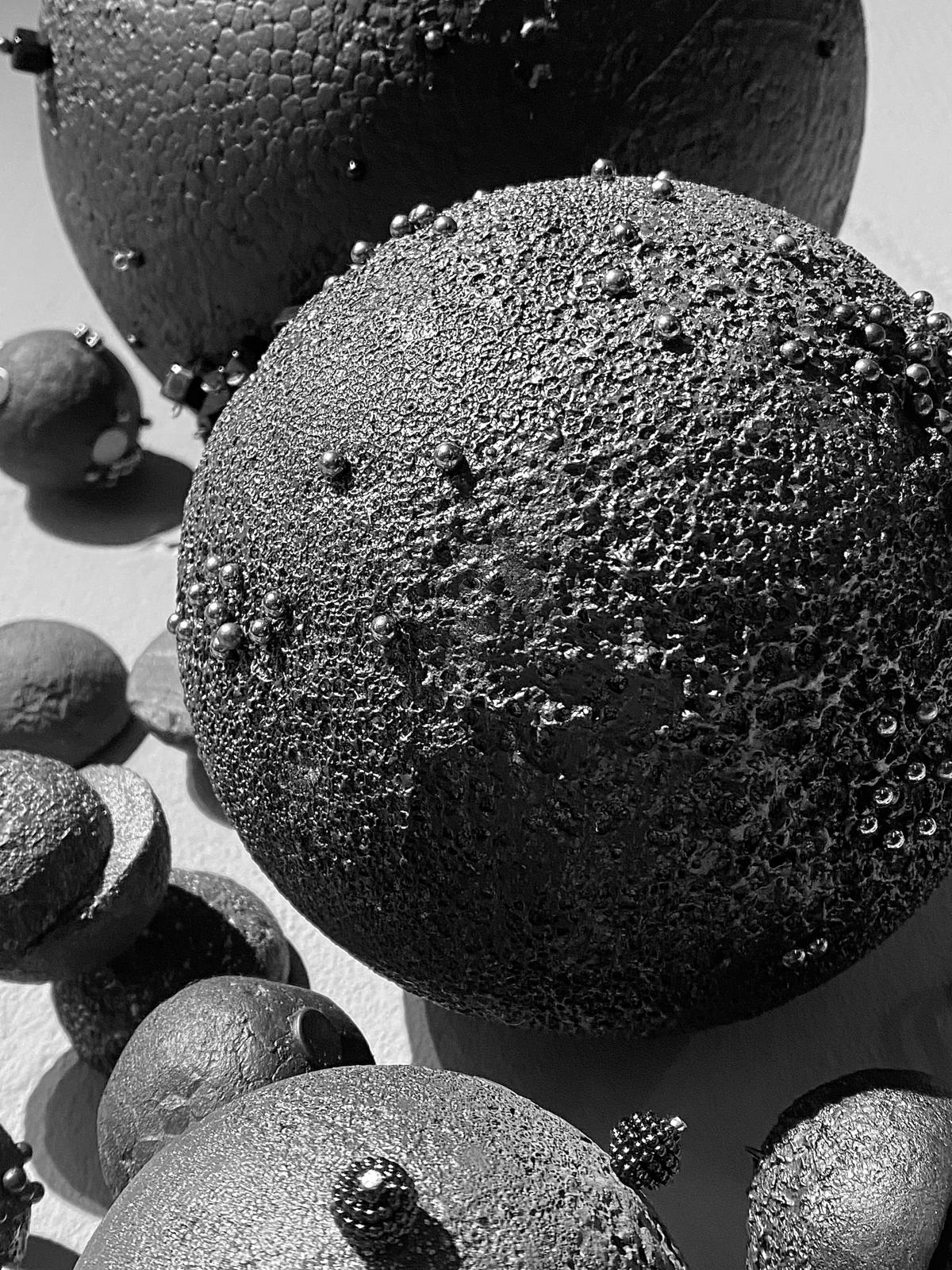
Rather than staging anxiety as a personal shortcoming, the exhibition exposes it as a systemic condition. The accumulation of black spheres, punctured by pins, wire, and corroded metal, constructs an environment in which protection turns aggressive, and safety becomes indistinguishable from threat. These forms do not merely occupy the space, they proliferate within it, suggesting a process closer to metastasis than to composition.
Malign densities
The black spheres operate as a dispersed system rather than as individual objects. Their matte surfaces absorb light, refusing reflection, which places them conceptually closer to voids than to volumes. Suspended, attached to the wall, or resting on the floor, they appear to migrate across the space, collapsing the distinction between sculpture, drawing, and spatial notation. Rather than functioning as symbols, the spheres behave as conditions. They mark the space as altered, unsettled, and continuously at risk of further occupation. In this sense, they articulate one of the core ideas of the exhibition: fear not as an event, but as a state that spreads, settles, and quietly reshapes the environment.
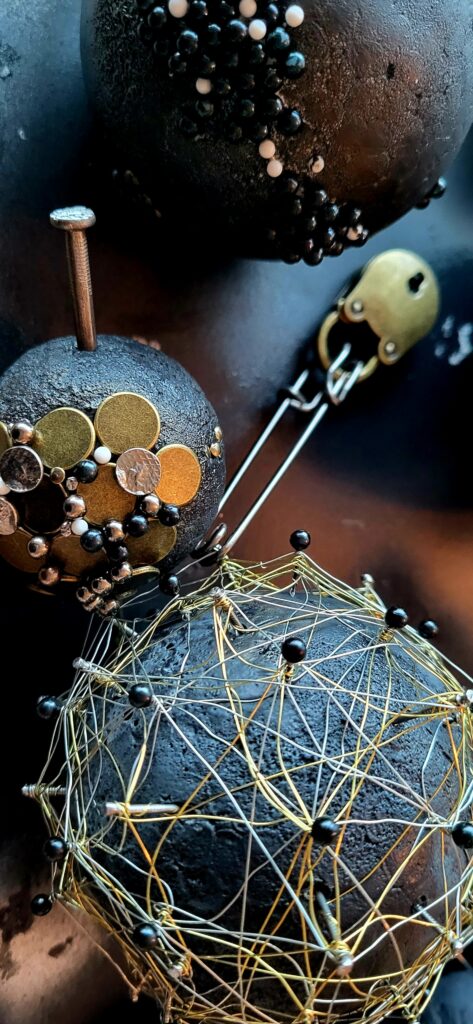
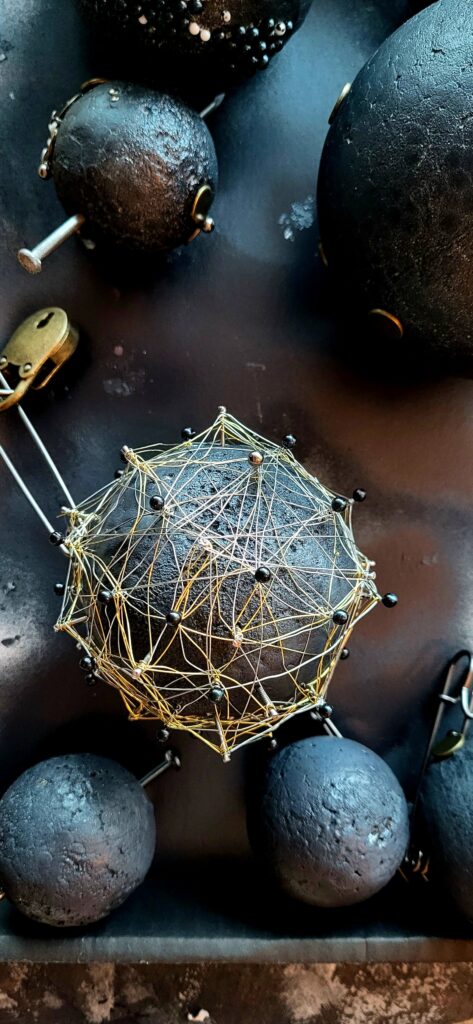
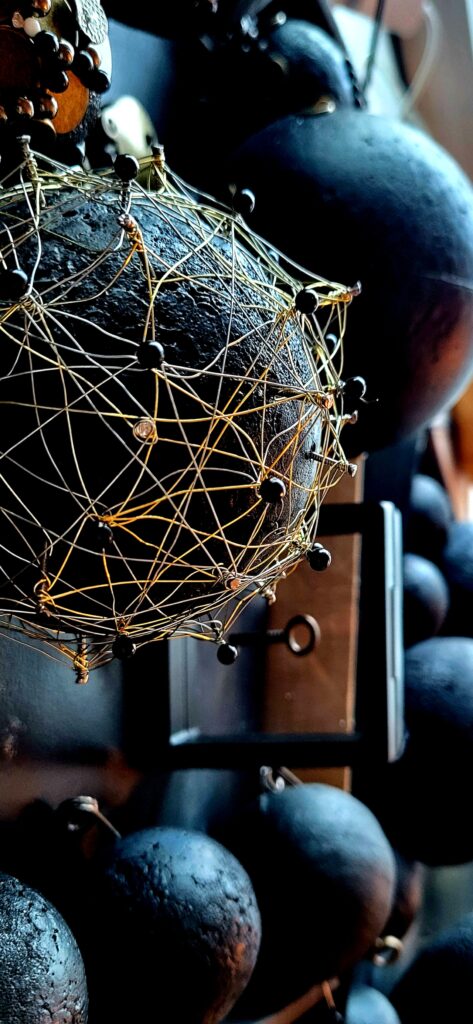
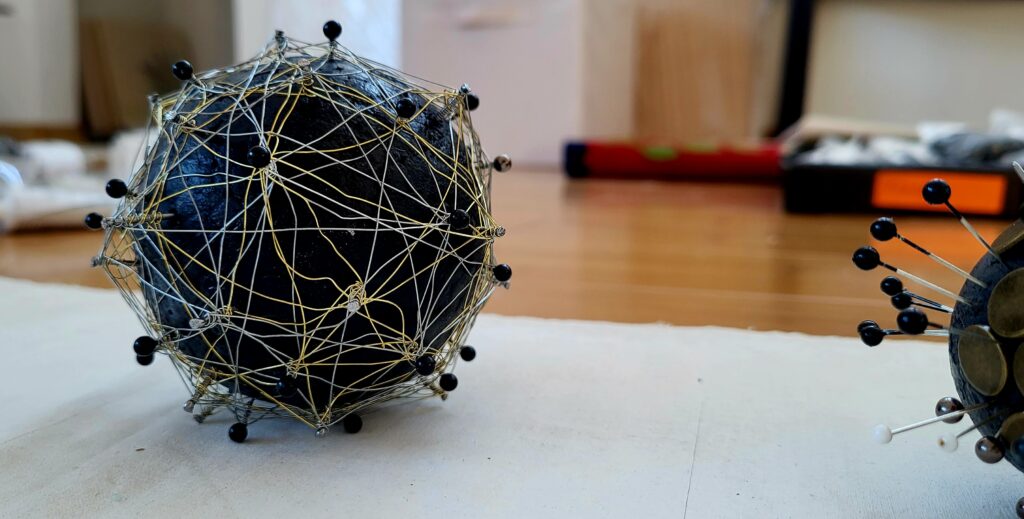
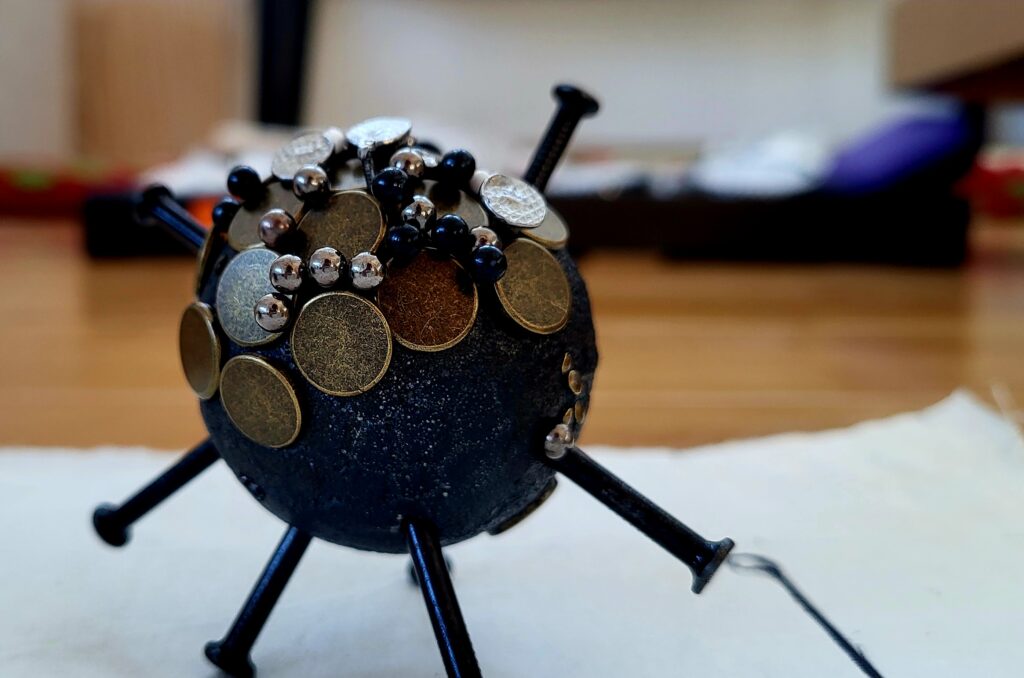
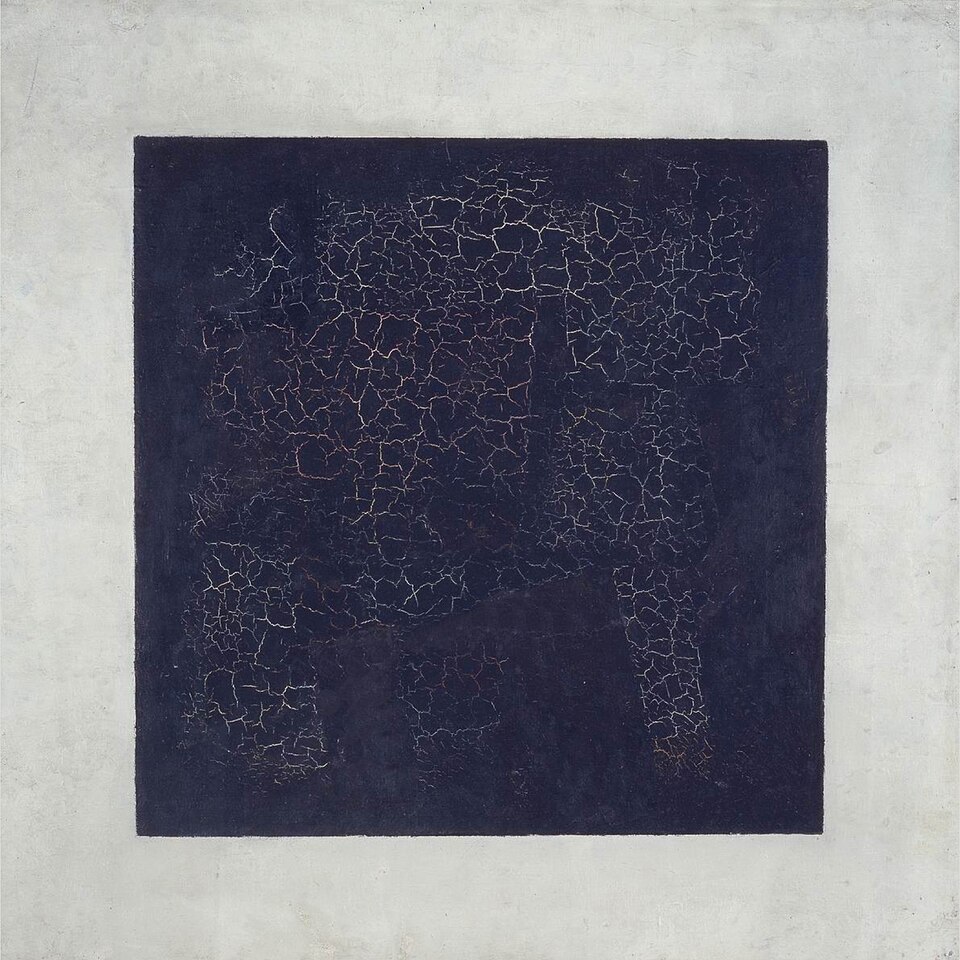
This proliferation establishes a quiet dialogue with the history of abstraction. Where Malevich’s black square proposed a radical transcendence, an exit from representation toward a purified absolute, Roxana’s black spheres signal a different condition. They are enclosures, multiplicities. The shift from square to sphere marks a movement from utopian reduction to experiential compression, from metaphysical aspiration to psychological density.
Failed Schematics of a Childhood Memory
Equally significant is the role of the diagram within the installation. Traditionally a tool of clarity and prediction, the diagram here registers failure. Its lines do not stabilize meaning, they testify to the breakdown of rational containment when confronted with affective complexity. These failed schematics reveal the limits of control itself, exposing structure as fragile and even provisional.
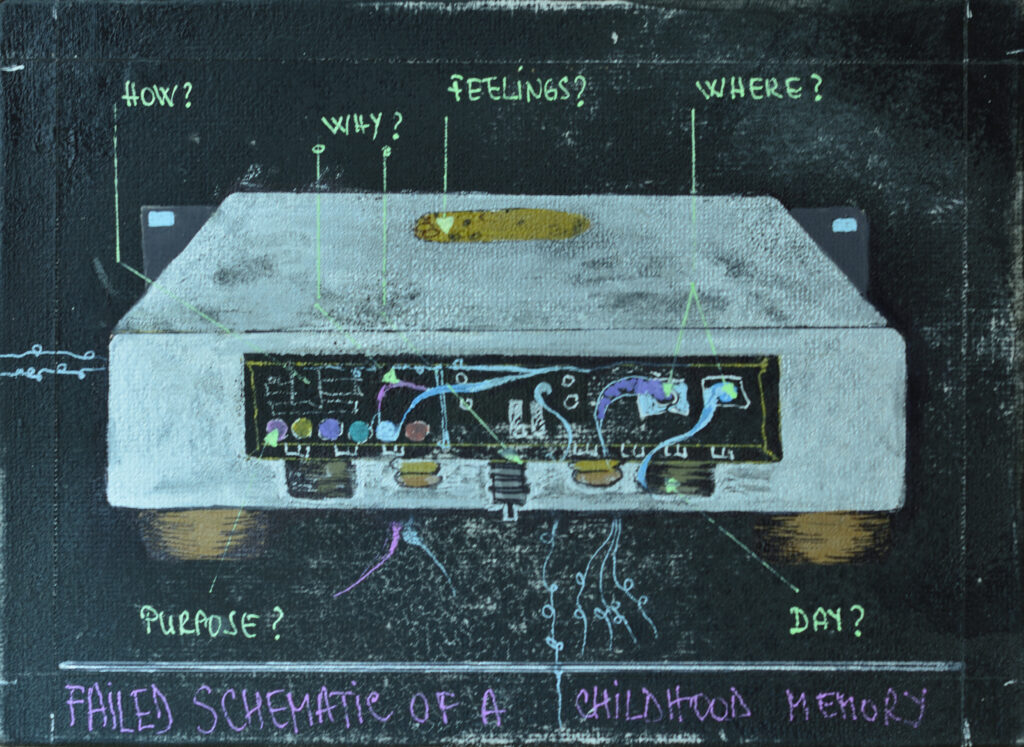
In Failed Schematics of a Childhood Memory, the diagram becomes a site of disorientation rather than explanation.
The familiar language of technical annotation—labels, arrows, and causal prompts such as “how?”, “why?”, “where?”, or “purpose?”—is retained, yet emptied of its stabilizing function. Instead of producing clarity, the schematic exposes its own insufficiency when tasked with mapping memory and affect. The structure promises coherence, but what it contains is fragmentation, hesitation, and slippage between parts. Childhood memory resists linear reconstruction, and the diagram’s failure becomes its most truthful gesture: a recognition that emotional experience cannot be reduced to functional logic without loss.
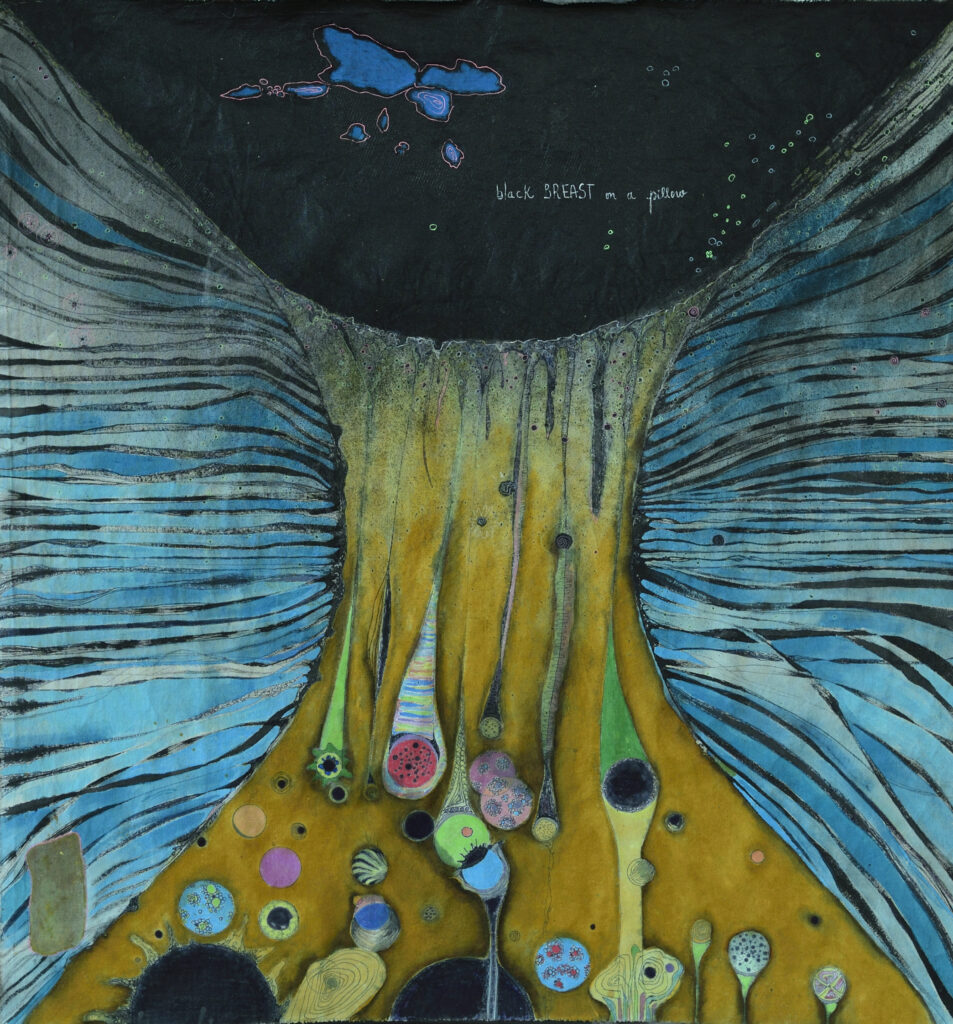
Black Breast on a Pillow
The body emerges as the final site where these tensions converge. In works such as Black Breast on a Pillow, vulnerability is rendered without metaphorical distance. The juxtaposition of softness and injury, of intimacy and disturbance, foregrounds the impossibility of separating emotional exposure from corporeal experience. This emphasis is reinforced by the tactile dimension of the installation. The materials repel touch while insisting on proximity, generating a sensory unease that implicates the viewer physically, not just visually.
This work concentrates the exhibition’s logic into an intimate, almost diagrammatic image. Black Breast on a Pillow stages the body as a site where care, vulnerability, and disturbance coexist without hierarchy. The composition opens laterally, like a suspended cross-section, revealing an interior landscape that oscillates between anatomy, geology, and vegetal growth. The breast, traditionally associated with nourishment and protection, is rendered here as darkened, compromised. Its blackness does not function symbolically as negation alone, but as density, accumulation, and blockage. What should circulate becomes heavy, what should soothe becomes opaque. The pillow, implicitly present through the title rather than through depiction, introduces a domestic register, a space of rest and trust, against which the image’s internal tension becomes sharper.
Black Breast on a Pillow thus becomes less a depiction of illness and more a meditation on exposure, on what it means for intimacy to persist even when safety can no longer be assumed.
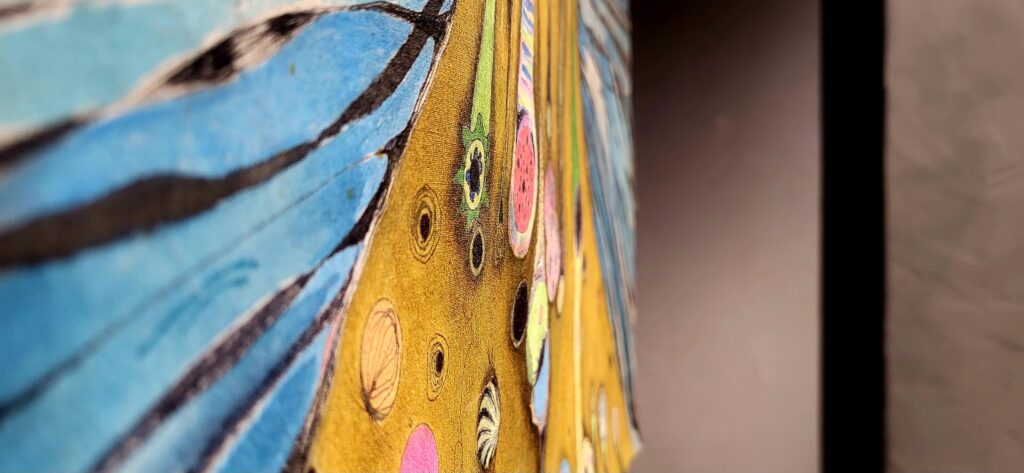
Through this constellation of forms, materials, and spatial strategies, Roxana constructs an aesthetics of vulnerability that resists sentimentality. Vulnerability is not framed as confession or weakness, but as a method of inquiry. The exhibition does not seek to soothe. It insists instead on remaining within the aftermath, within what persists after defense mechanisms collapse.
What emerges there is not closure, but a more demanding form of awareness.
Safety First – The Aftermath ultimately proposes that when protective systems fail, something else becomes visible: a knowledge grounded in exposure, and it is within this unresolved space that the work situates the viewer, inviting not reassurance, but recognition.



Lasă un comentariu