
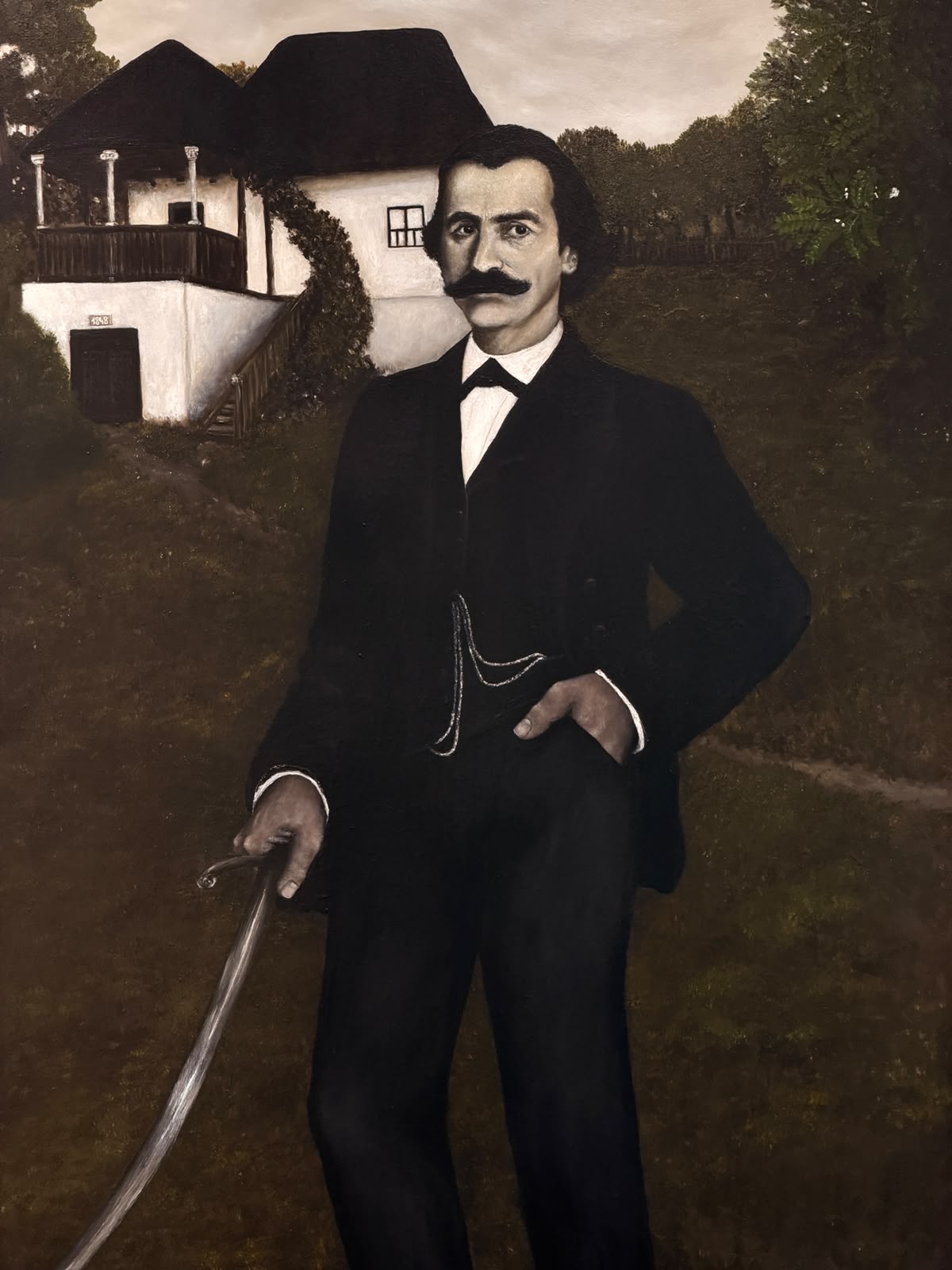
Even today, almost 150 years after his death, Gheorghe Magheru continues to inspire people. He stands as a measure of respect, for oneself, for others, and, perhaps most important, for Romania.
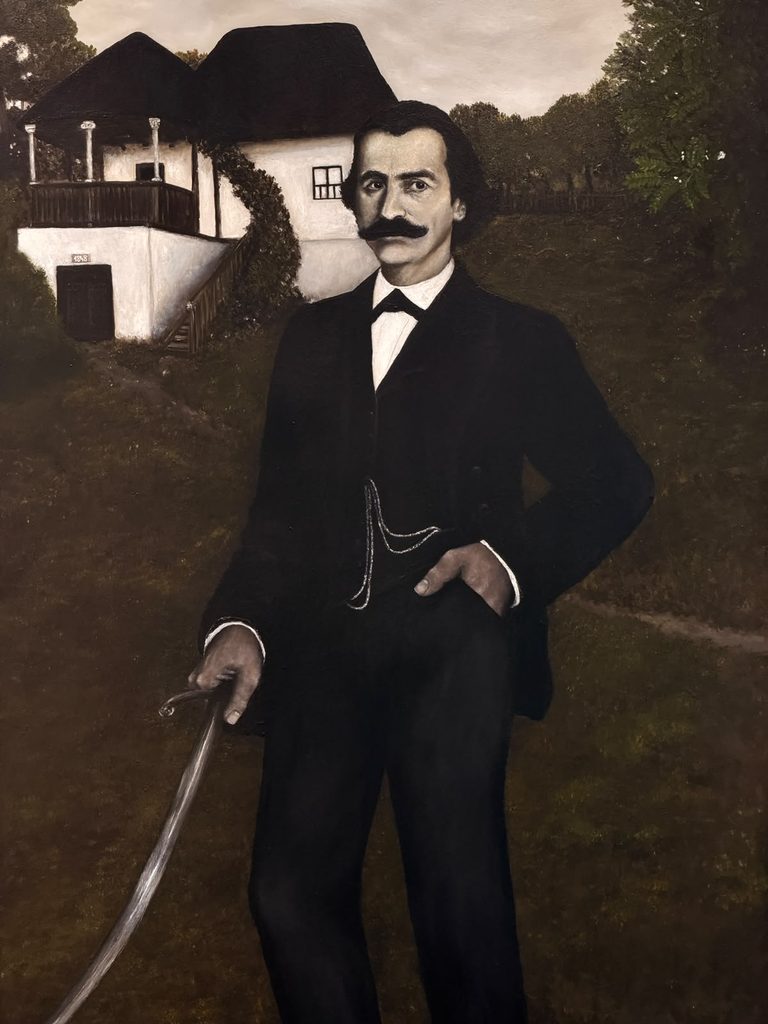
In this posthumous portrait that you can find at Magheru HUB, right in the heart of the city, very close tot the Magheru Boulevard and Piața Romana, Diana Zamfir (Marinescu) builds a representation of Gheorghe Magheru mixing specific symbolic details with her own artistic vision. The result brings back, into the present, the image of a man who walked beside his people before anything else, and who supported the cause of a free Romania until the end, a cause he fought for even from exile, largely through his membership in the Frăția society.
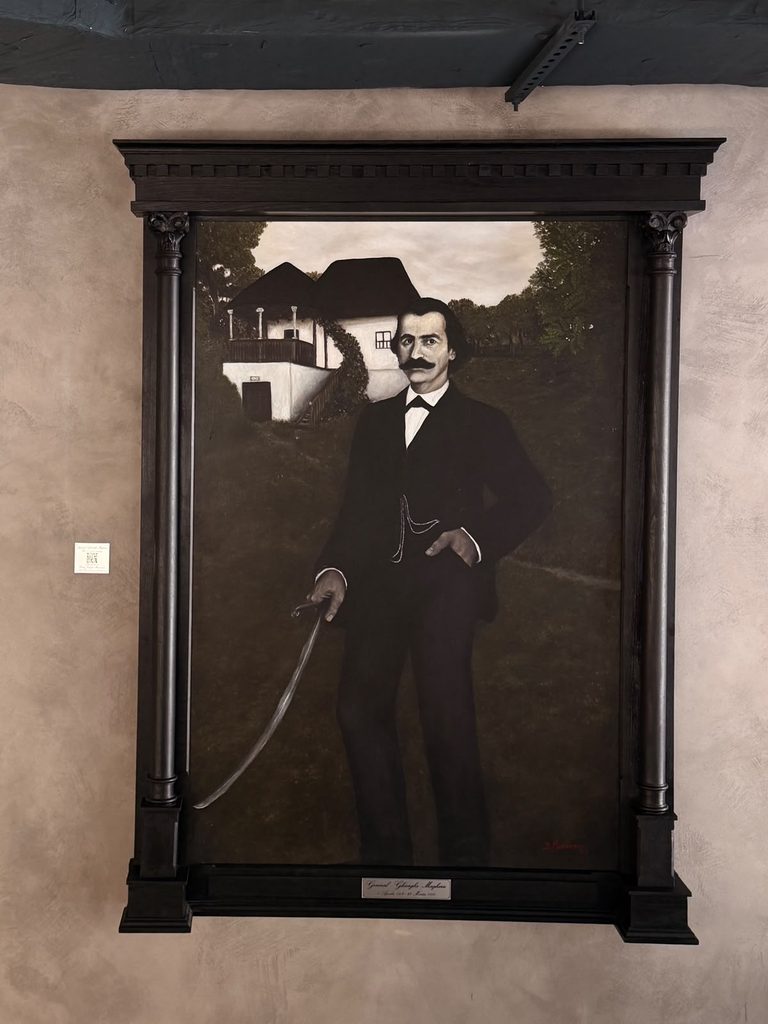
The artist painted this portrait in 2025, the title carrying the key to the artistic intention behind the work, “a man among men.” The composition splits into two parts. On the left stands a white house with a dark roof and a wooden balcony held up by three columns of the classical orders, Doric, Ionic, and Corinthian. Ivy runs along the stairs and wraps around the top of the railing. The overall look of the house belongs to the Gorj region, and places the scene inside the historic ground where Magheru was born and where he fought beside Tudor Vladimirescu.
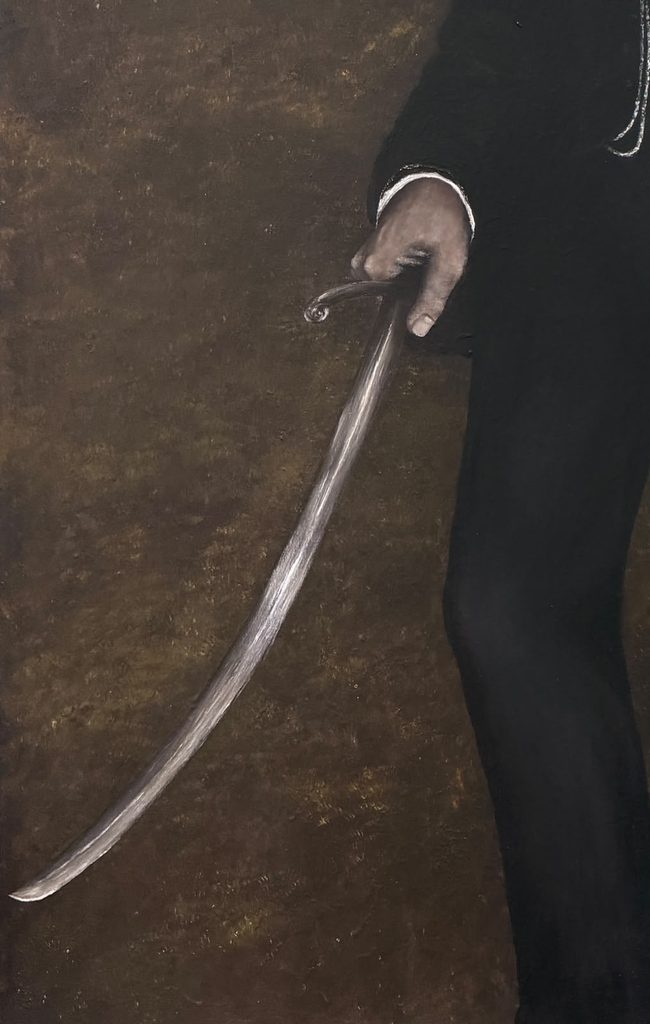
The right side of the painting holds the imposing figure of a man who was, in turn, an outlaw fighter, a pandur, a leader of the 1848 revolution, a member of the revolution’s government, and an army general. He wears a black suit, a white shirt, and a thin bow tie. His posture stays relaxed, one hand in his pocket. The other hand holds a slightly curved sword at his side. A pocket watch shows through the chains visible near the waist of his vest. His mustache draws the eye first, framing a face marked by combed-back hair and a piercing gaze holding your own gaze in return.
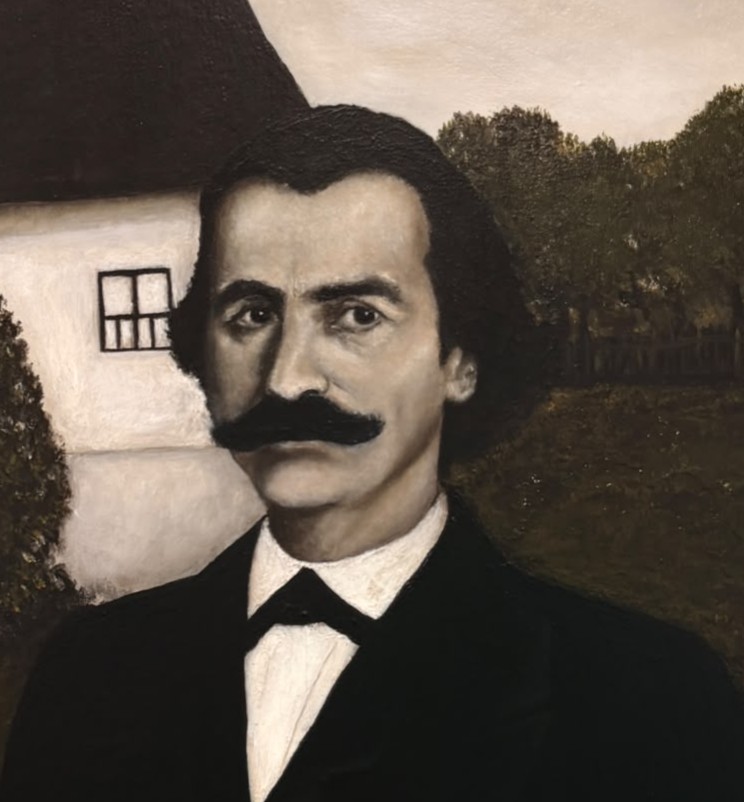
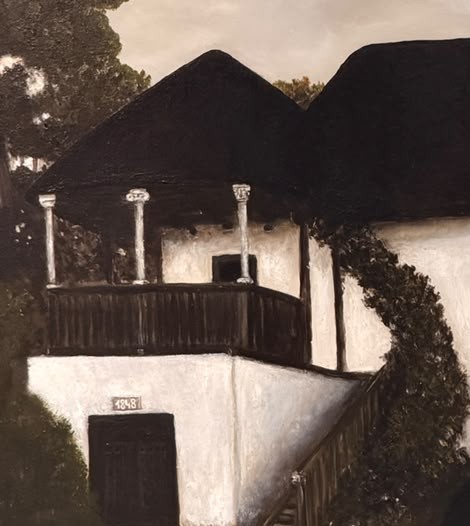
Diana Zamfir (Marinescu) paints with fairly even, flat light. Shadows stay soft. The meadow behind him reads as texture more than depth. The trees behind the house keep simple outlines. This flat overall look gives the piece the air of an old family photograph, an almost private memory rather than an academic, realist scene. The style supports the man himself. Magheru was known for staying close to the people he fought beside, and grandeur had no place in his life or in this painting.
The color palette carries a strong emotional charge built through contrast. Dark tones and the black of the figure dominate, drawing your eye along the blade of the sword, the one element breaking the vertical line of the body. White marks the shirt, the house, and the sky, neutral accents next to the green of the vegetation.
One striking element is the frame, extending the ideas inside the painting. Made from dark wood, the frame carries two slender Ionic columns and a classical architrave, borrowing the language of classical architecture to build the look of a “state portrait.” Tension shows between the painting and the contemporary setting around the frame, and this tension makes history feel present through what followed him, without losing authenticity.
In the end, the house in the painting stays more present than the sword or the suit. The Gorj house shaped Gheorghe Magheru, and he fought his whole life for “home,” and for country.
Today, one of the largest boulevards in Romania still carries his name. The same boulevard once ranked among the most expensive commercial streets in the world. Boulevard Gheorghe Magheru links Piața Universității to Piața Romană in Bucharest, another road marked by the name of a man who chose to stay a man among men.

Lasă un comentariu