
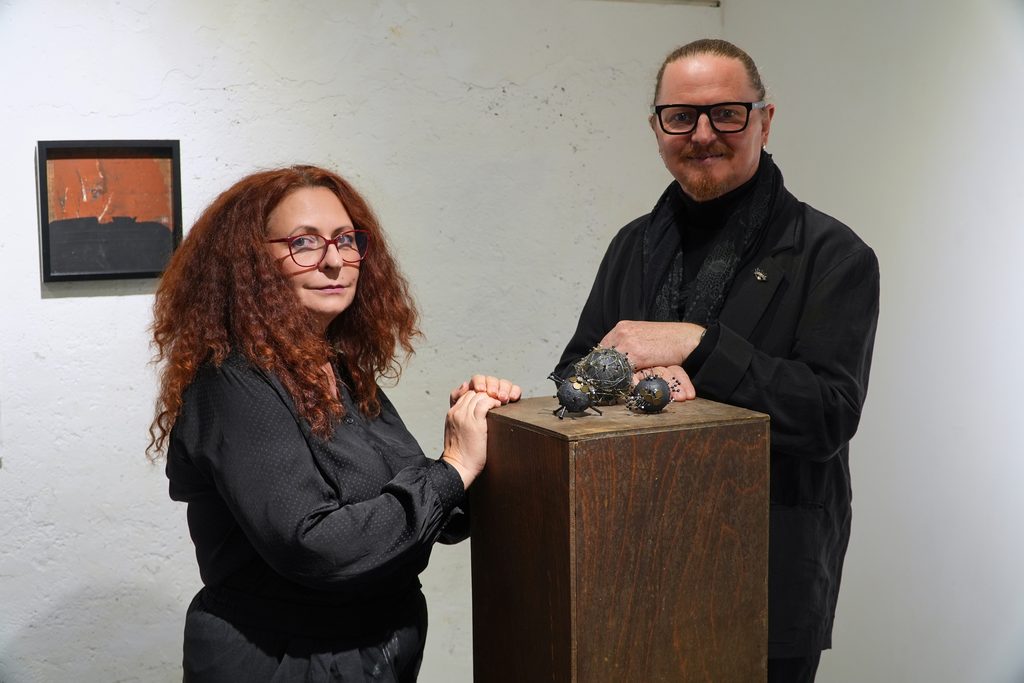
Artist: Roxana Donaldson
Curator: Florin Marin
Photography&Media: CTRL Creative
Artistic Direction: Andrei Fășie
Roxana Donaldson builds her practice as long-term artistic research, where painting, assemblage and installation work as stages of the same investigation. In Safety First, the project I wrote about last year, the artist treated safety as an affective construct, and fear appeared as a state which spreads, settles and quietly reshapes the space. A feminine archive of fear continues this research and changes its scale. Fear no longer belongs to an anonymous system. Fear now has a family, a female line, a repeated name and even a few calendar dates.
The installation(s), modular and always changing, was shown in different configurations at Galeria 9 in Brașov, in 2025, and at Galeria Brateanu in Timișoara, in 2026. In Bucharest, the curator Florin Marin, sculptor and dean of the Faculty of Fine Arts in Cluj proposed a new arrangement. The support remains the familiar one, the recycled bed sheet, joined by worn wood, spheres, string, waxed thread, silk and wood dust. The exhibition speaks of a poor and dignified matter and places her approach at the meeting point of Conceptualism, Process Art and Arte Povera.
“There is a category of existences which left no documents. Not because they did not live, but because the instruments of archiving were not built for them,” the artist writes. The anonymous woman appears in official registers three times, at birth, at marriage and at death. Between these dates lies an empty administrative space. The exhibition starts from this void, and the reading I propose here follows its most insistent form, the knot.
Knot/Node, nodule, rhizome
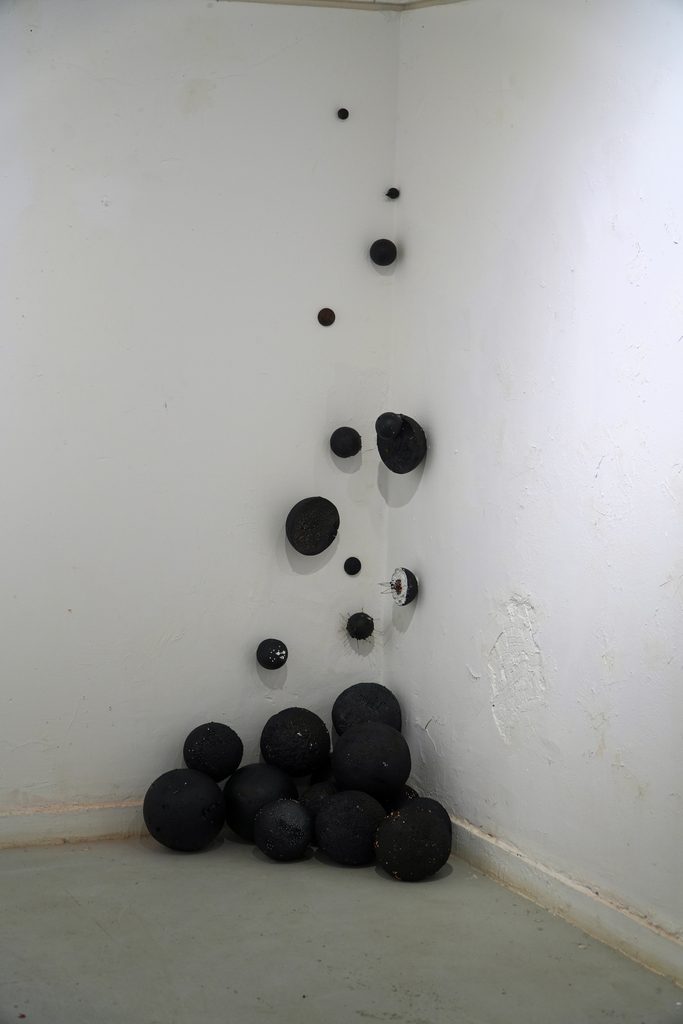
Romanian keeps two words from the same Latin root. The „nod” is the knot holding a thread taut, and the same word names the node on a stem. The nodule, its diminutive, became a medical term and names a small, dense formation, closed in on itself, which the doctor palpates and measures. The first ties two things together. The second separates from the surrounding tissue. In Safety First, the black spheres scattered across the walls read in the second register. I called them „malign densities” then, and pathology became a ground for knowledge.
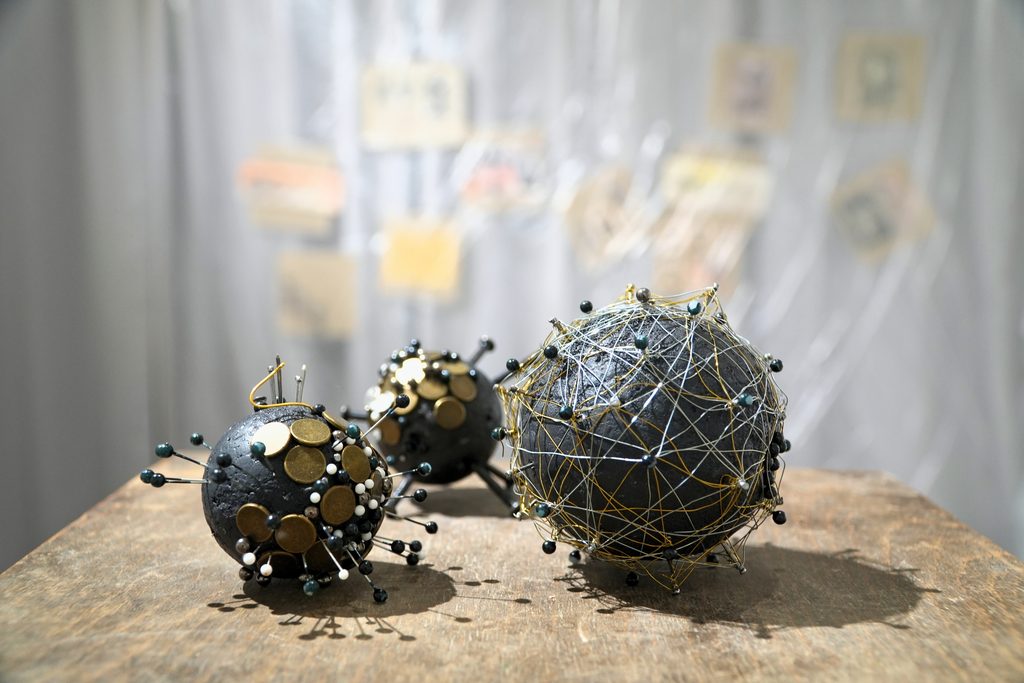
In a feminine archive of fear, the direction reverses. The knot no longer closes. Botany gives the word a third meaning, the closest to what the room shows. On a stem, the node is the point where leaves, buds and roots begin. The rhizome, the underground stem growing horizontally, is a row of such nodes, and each of them is able to produce a new plant even when broken off from the rest. I call these points fertile knots.
Deleuze and Guattari made the rhizome the opposite of the tree. The tree assumes a root, a trunk and an order of descent. The rhizome connects any point to any other, has no centre and, broken in one place, starts again on an old line or on a new one. The two authors call the rhizome an antigenealogy. The wording fits what the artist describes as “the filiation of the horizontal network, a solidarity between anonymous existences, a connection which does not submit to hierarchy”. The written family tree follows the father’s name, and the women of the family appear there only in passing. The string crossing the boxes ties them differently, horizontally, from one to the next.
Maria Without End
The central piece of the exhibition is Maria cea fără de sfârșit (Maria Without End), mixed technique on recycled bed sheet, 70 x 100 cm. A brick-red field occupies the upper part of the canvas, and black masses press in from both sides. The red descends between them and thins into a few lines reaching the bottom edge. The title is handwritten in the red field.
The support matters as much as the image. The bed sheet is not, as the artist says, the neutral canvas of art history. The sheet is the material which absorbed birth and death in private spaces, left outside any public archive. Bed sheets also counted among dowry goods, and the artist recalls the dowry sheet as the only document where the woman appeared as a subject, only to be transferred at once as an object. The painting is therefore made on the object which accompanied the woman into marriage.
Here the first fertility appears, the imposed one. Offspring were expected from the marriage, and the woman’s value in the eyes of the administration was her capacity to give birth. Roxana Donaldson turns this logic around. On the cloth where people were born and died, signs now grow. Fertility moves from body to form, and the bed sheet, as the artist writes, has transmuted into a document. The red line descending through the black reads both ways, as descent and as thread.
The name in the title returns throughout the exhibition. Maria appears in the panel maria fiica lui și a (maria daughter of and of), among the signs of semne (II) and in the object semne (VI), a narrow wooden box with five compartments, one for each letter. The name belongs to real women in the artist’s family, but repetition removes the name from biography. Maria becomes a series. The artist speaks of an exercise in exhausting the word until the word turns into pure sign, and of anonymity as a structural condition. “If we named them, we would be lying,” she writes about these presences without biography. The title maria fiica lui și a, left unfinished, says the same thing with the means of the form. The field exists, the parents’ names are missing.
The name behaves here like a fragment of rhizome. The name passes from one woman to another and takes root again, each time in another body. The title of the central piece names this very property. A Maria without end is a line which does not close with any particular woman. Marianne Hirsch called postmemory the relation of later generations to a trauma they did not live through, but received through gestures, silences and objects. In Roxana Donaldson’s works, this transmission has a precise form. Fear does not arrive as a story. Fear arrives as a knot, tied by one hand and received by another.
This is the uncomfortable part of the concept. A fertile knot does not choose what grows from there. Fear multiplies along the same path as care, and the exhibition does not separate them.


Born on / Died on / Nothing
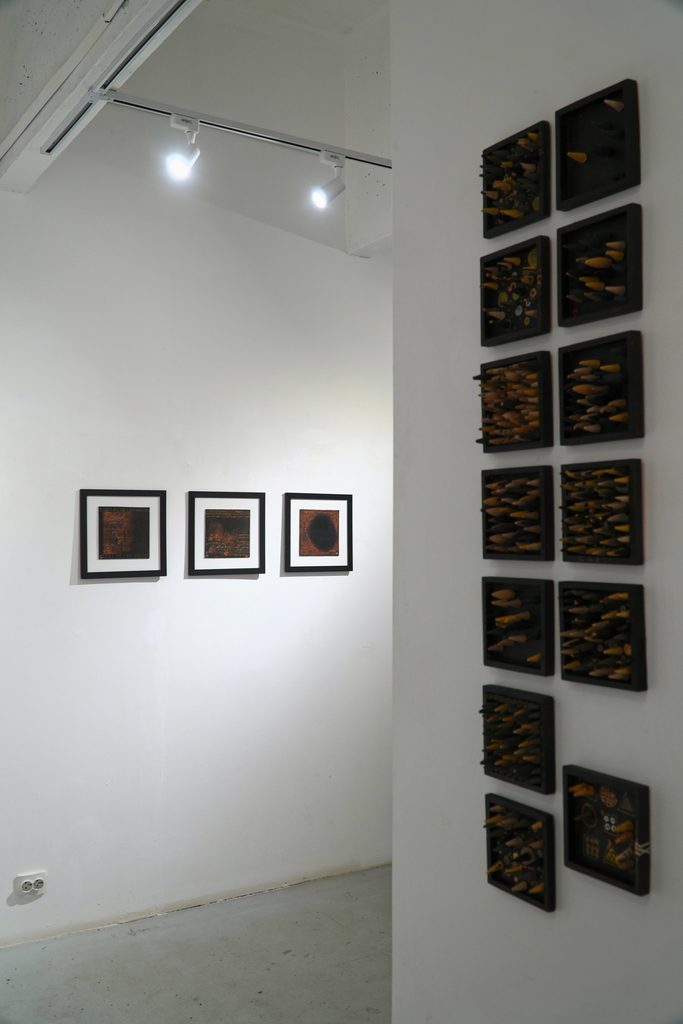
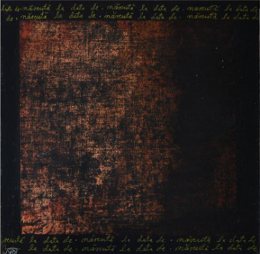
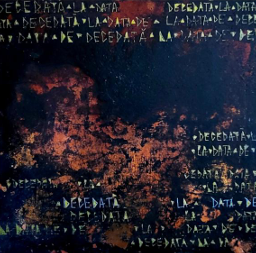
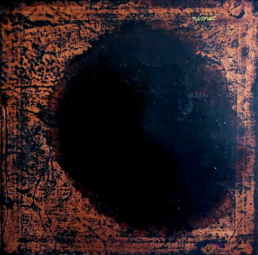
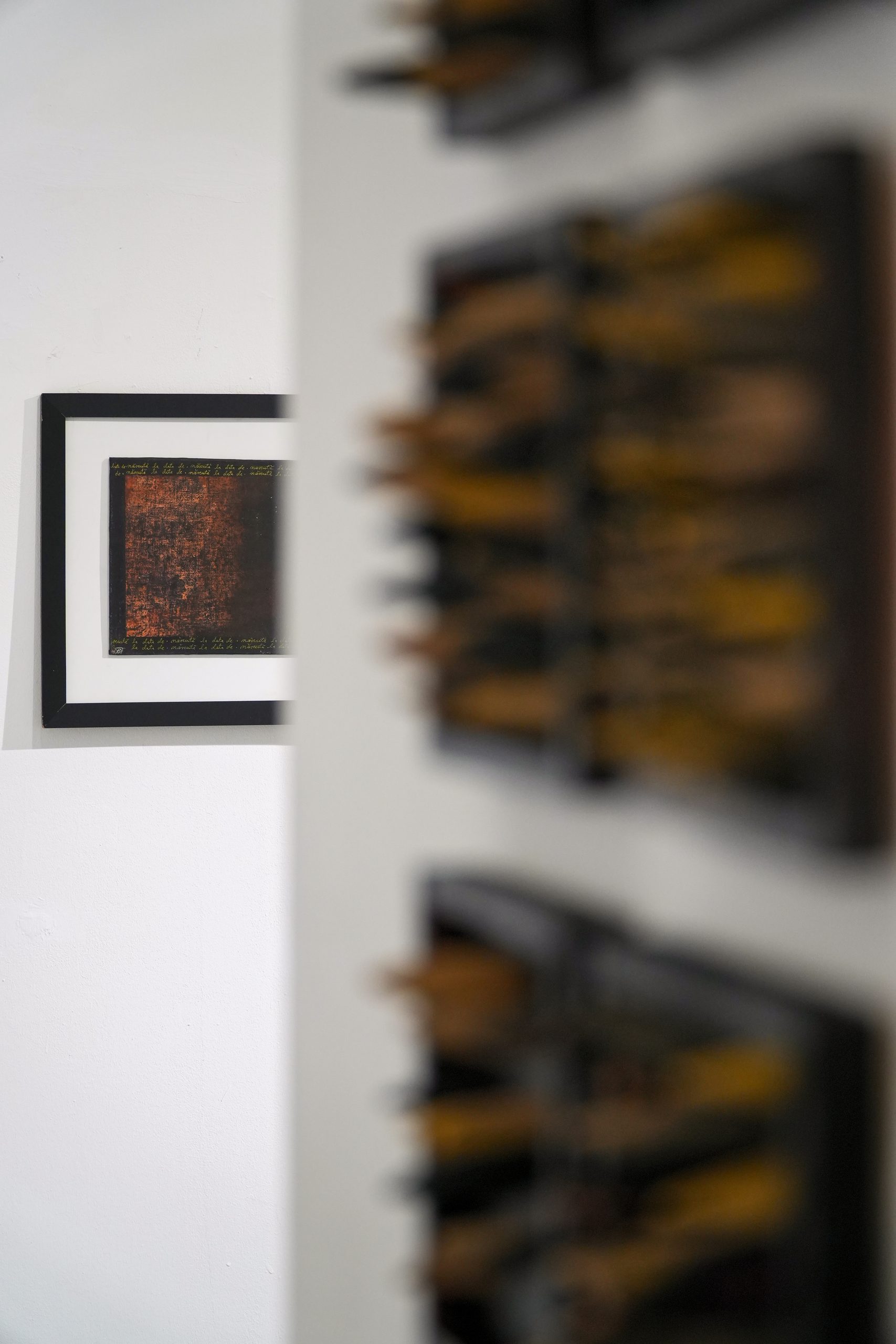
Three small panels, 20 x 20 cm, worked in acrylic and ink, take up the civil status form. On the first, the words “născută la data de” (born on the date of) repeat along the edges, around a rust-coloured field darkening towards the right. On the second, “decedată la data de” (deceased on the date of) covers the surface in rows of capital letters separated by small triangles. The third is almost entirely occupied by a black disc, and in one corner, written small, sits the word “nimic” (nothing).
The series translates into painting the pattern of appearances in the register. Birth and death have their formula. The life between them has a single word. Botany calls internode the portion of stem between two nodes, and the comparison helps in reading the black disc. The disc does not figure an absence. The disc is dense matter, worked in layers, the place where everything the documents did not retain took place.
Another work titled născută la data de takes the pattern further. On a black ground sit four light fields, populated by small circles, triangles and squares, linked by thin drawn threads. Between the fields two dates are written, 15.08.1914 and 05.03.1977. They are the dates of women in the artist’s family. The composition looks like a rhizome seen from above, with four knots and the links between them, with no trunk and no top.
Archival Boxes
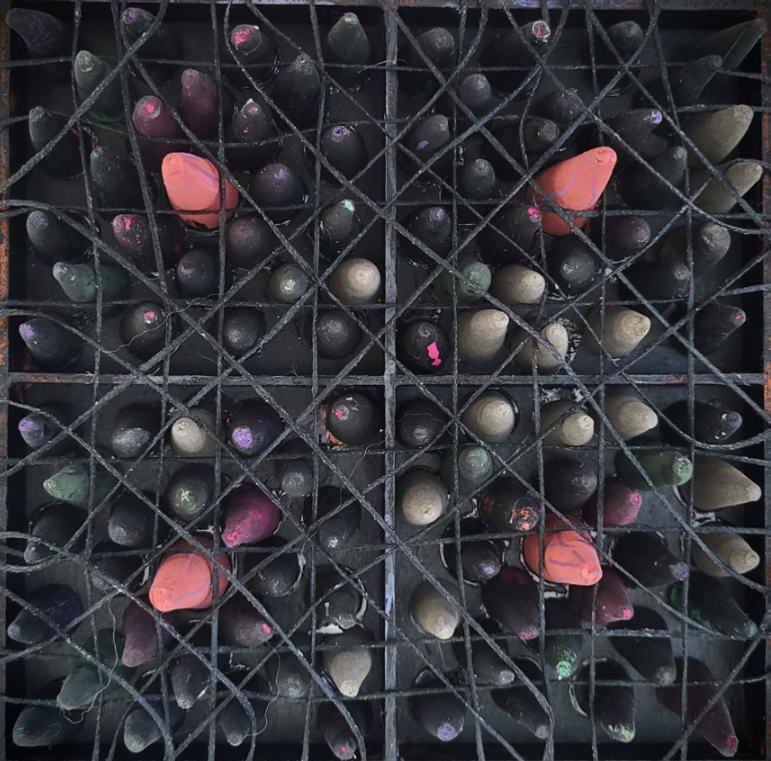
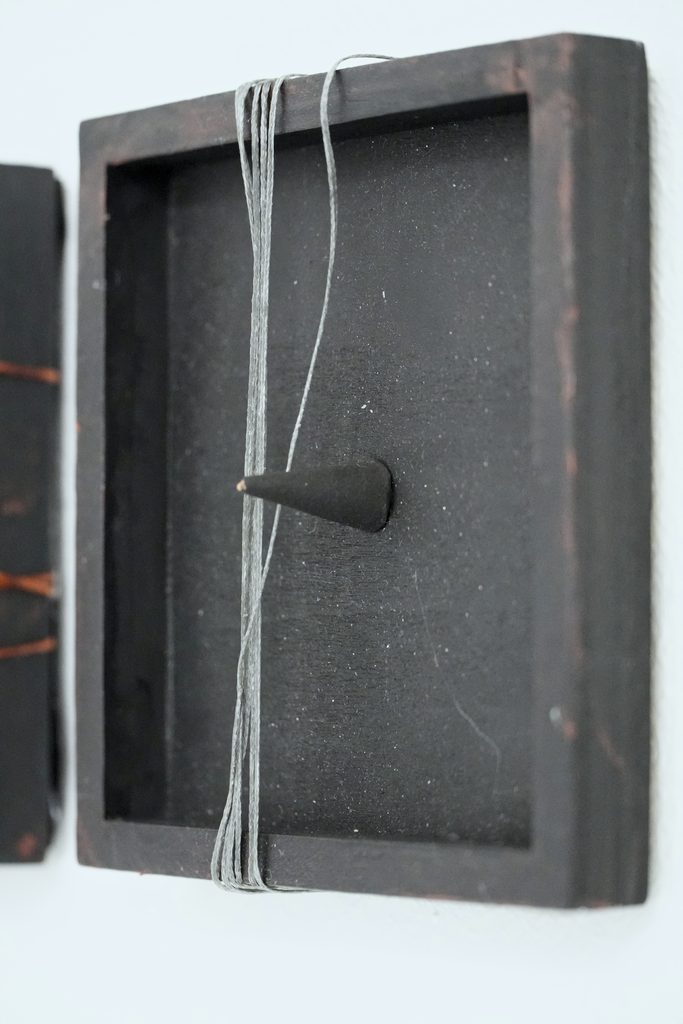
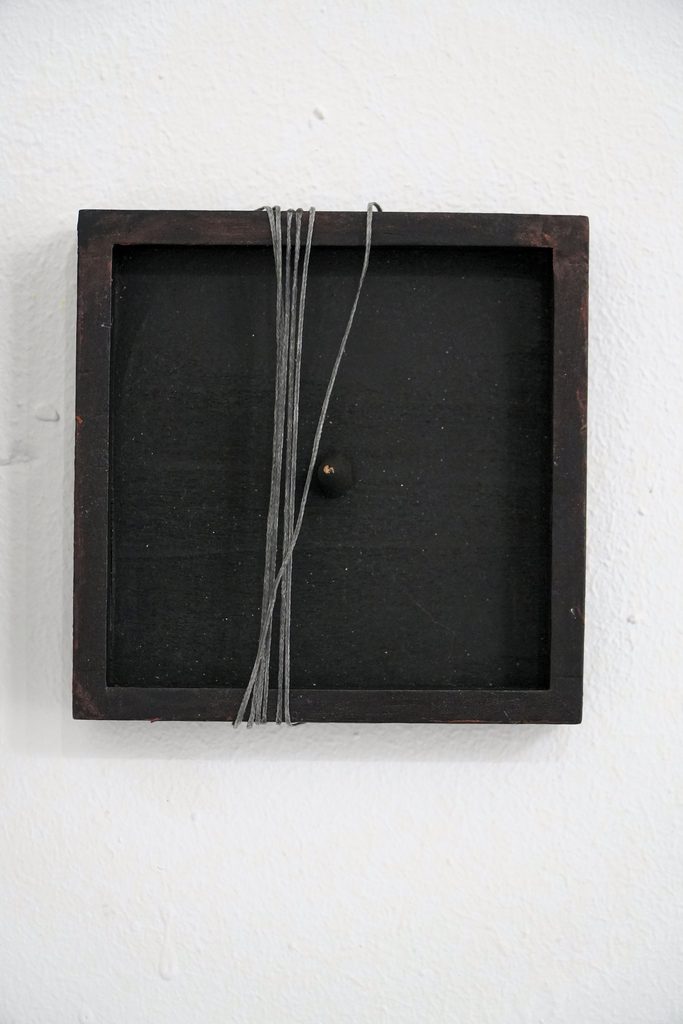
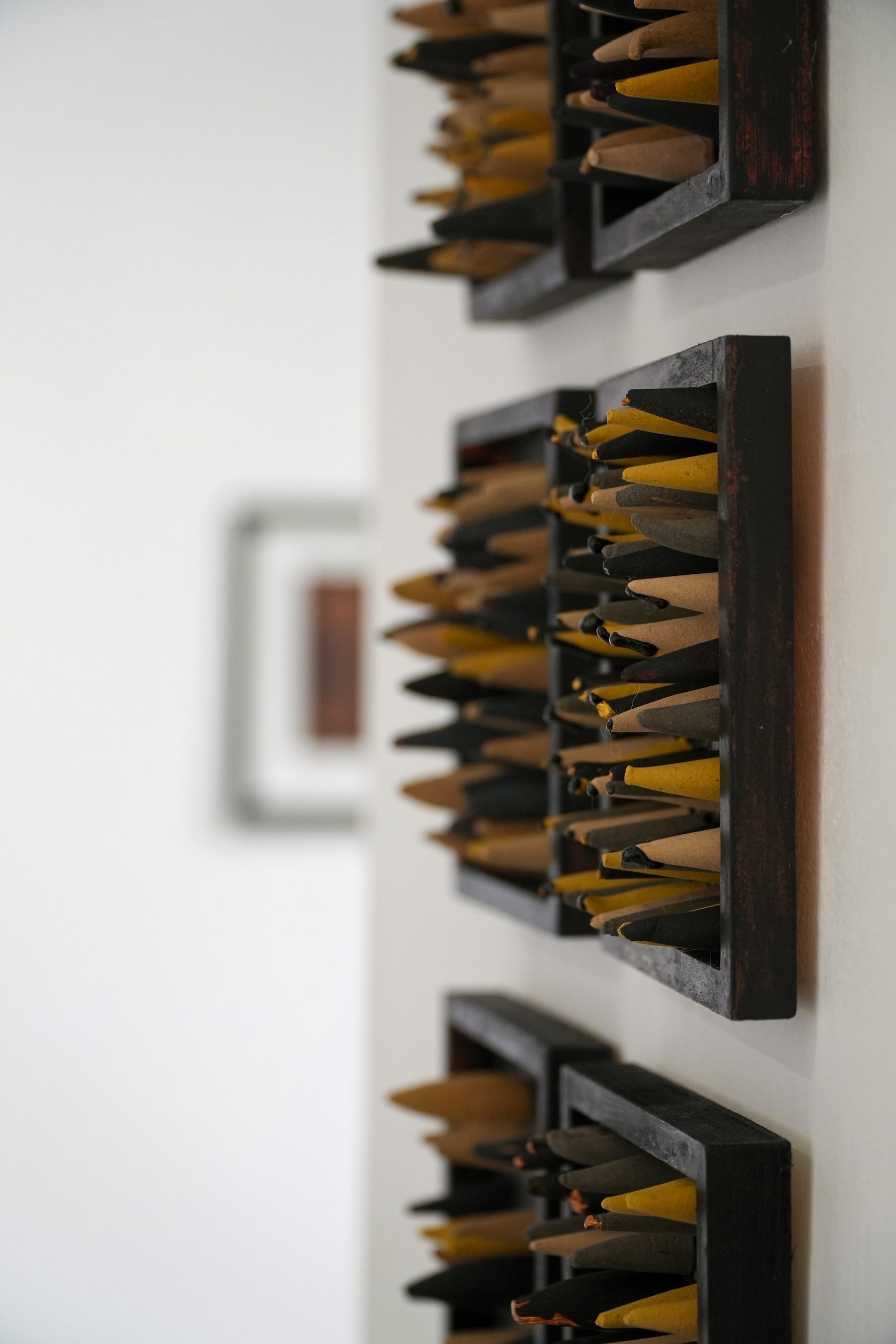
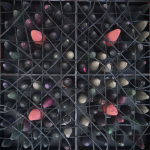
The assemblages take painting into three dimensions. Square trays of wood painted black, 11 or 12 cm on each side, shelter small cones of wood dust, some black, others ochre, yellow or pink. Over them run lines of string, waxed thread and silk, stretched from one edge to the other. In some boxes the cones stand in a tight grid. In others two or three remain, and the threads go around them.
The artist describes these forms as minimal units of existence and says the trays are at once collections and unidentified graves. The taxonomy organising the installation is, in her words, a deliberate irony. Classification was an instrument designed by men for a world of men, and the question the project asks remains open, “is classification anything other than a sophisticated way of opposing entropy?”.
The reading of the fertile knot adds a third meaning to these two. Set in rows, the cones resemble buds or seeds put out to sprout, and the box resembles a seedling tray. Here the archive also keeps what is yet to grow. The threads matter as much as the objects they tie. They cross each box from one side to the other, and the arrangement in a row on the wall extends them, for the eye, from one box to the next. No box stands above another in importance. The series accepts rearrangement, and the modular character of the installation, different in Brașov from Timișoara, belongs to the same logic. A rhizome has no final form.
Conclusion
Safety First ended in an unresolved space, where the viewer received recognition instead of reassurance. A feminine archive of fear keeps this honesty and adds a direction. The pathology of then, with its closed densities, gives way to a form which ties and sends out shoots. The passage from nodule to fertile knot heals nothing and promises nothing. The passage shows how what was handed down the female line, together with the bed sheets, the names and the fears, allows itself to be tied again, by another hand, in another pattern.
Roxana Donaldson calls the result a meditation on dissolution, steeped in a clinical melancholy. Seen from the knots, the exhibition is also a work of multiplication. Each box, each Maria and each sign adds a point to a network which has no top and, for this reason, has no end either.


Lasă un comentariu