
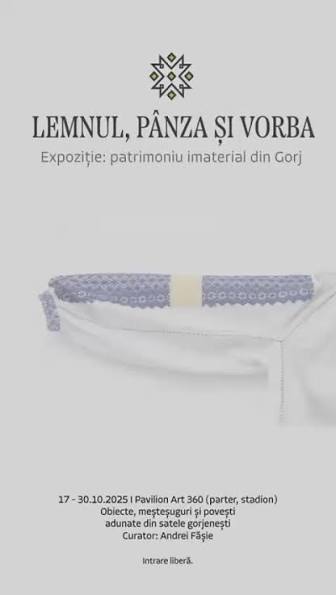
Exhibition
Curated by Andrei Fășie
Pavilion Art 360, Târgu Jiu
17 to 30 October 2025
An exhibition on the material and intangible heritage of Gorj. Over 300 authentic objects from ten villages sit in dialogue with paintings by Diana Marinescu and Roxana Donaldson, around three themes, wood, cloth and word.
About Lemnul, Pânza și Vorba
Lemnul, Pânza și Vorba (Wood, Cloth and Word) opened on 17 October 2025, Intangible Heritage Day, at Hub Cultural Pavilion Art 360 in Târgu Jiu, on the ground floor of the municipal stadium. About 200 people attended the opening. Entry was free.
The exhibition gathered more than 300 authentic objects from the Alexandru Ștefulescu County Museum, from folk craftspeople and from collectors in ten Gorj villages. Field research ran from July to October 2025. In Runcurel and Rătez, the team found villages that are almost deserted.
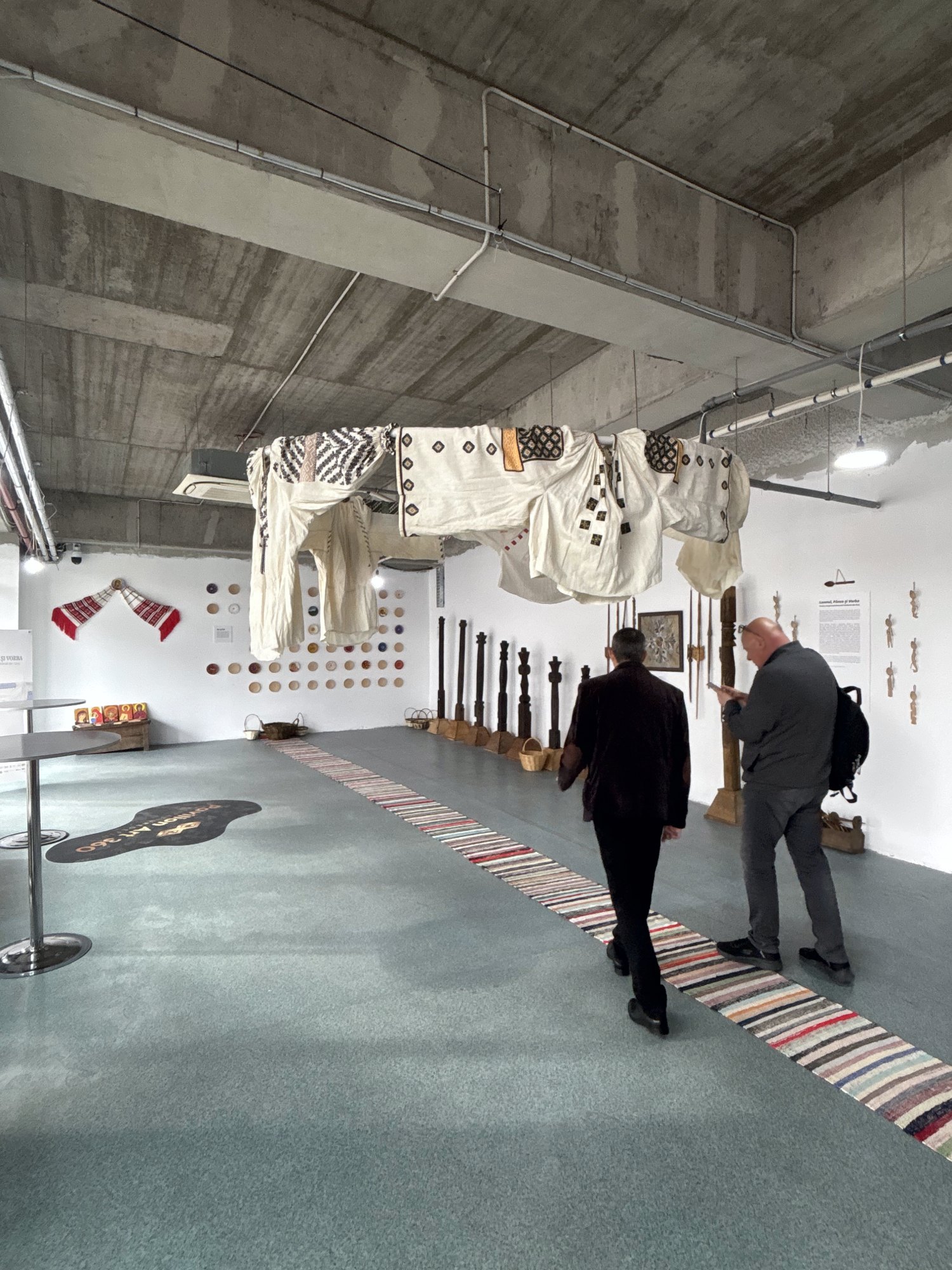
Among the pieces were carved wooden pillars over 200 years old, scoarțe and borangic marame from the early 1900s, hand-embroidered blouses and a carpet made by the League of Gorj Women under Arethia Tătărescu. Eight craftspeople led four workshops in the summer of 2025, on weaving, knitting, sewing and painting on wood and ceramic. Objects from these workshops were part of the show.
The painter Diana Marinescu made a series of works for the project, with scenes from village life. Roxana Donaldson contributed the painting Axis Mundi. Read more about the painter in Diana Marinescu, From Gesture to Grace. The project continued with A Blouse the Size of a Village and Itineraries and Traditional Gates.
The exhibition closed on 30 October 2025 with a finissage dedicated to taste as heritage.
Curatorial text
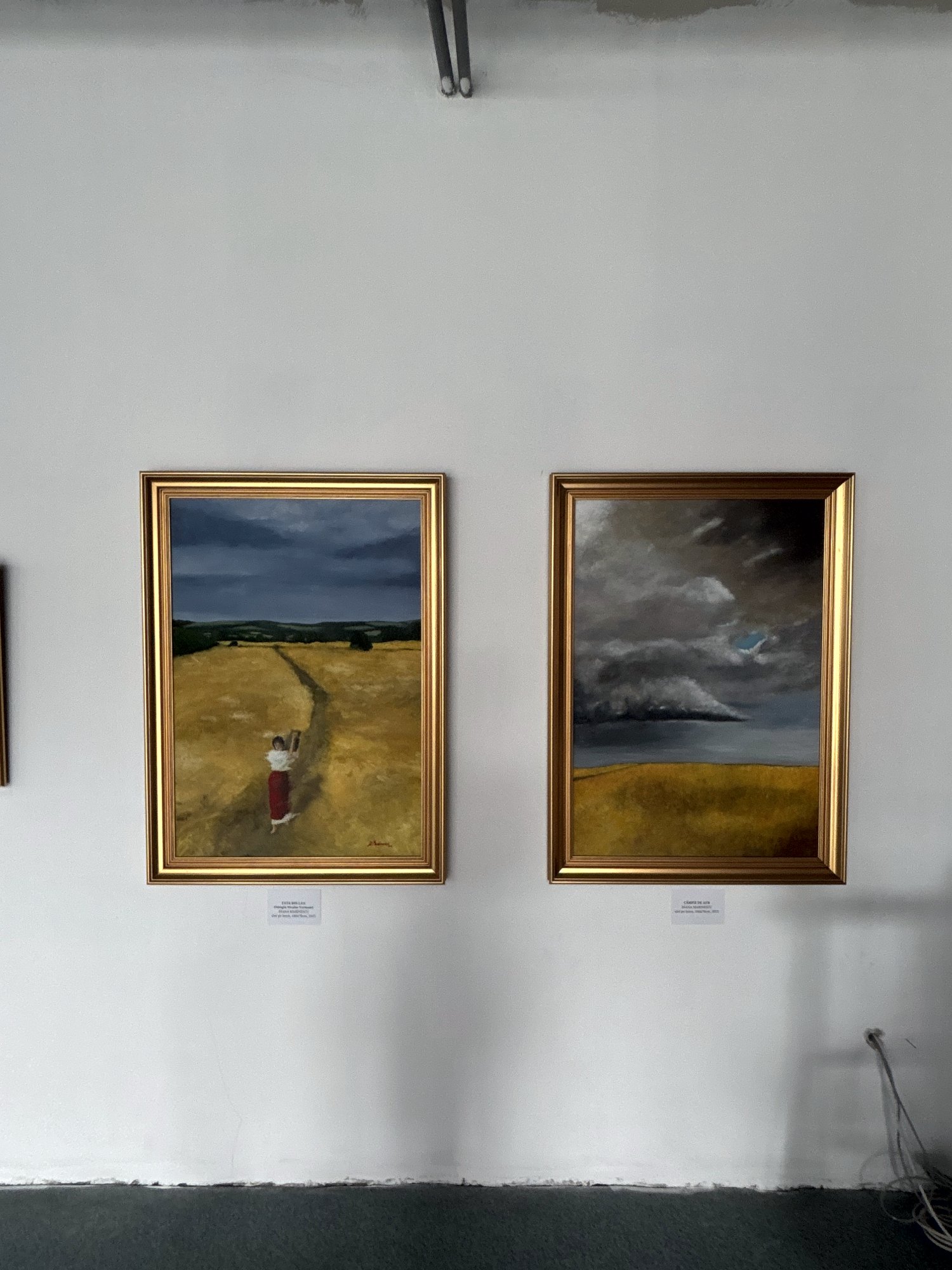
I wanted the dialogue between painting and the traditional object to flow naturally and to go beyond the frames of the paintings. For this reason, I proposed a juxtaposition of shared elements (the călușar costume, the traditional door and window) and a placement of the paintings among the heritage pieces. On one side, Roxana Donaldson’s painting offers a symbolic and intuitive introduction, at an archetypal level, into the sacred sphere, which was far better integrated into village life. On the other, Diana Marinescu’s paintings immerse us in village life through rural characters and landscapes, and their compositional tributes to Nicolae Vermont and Nicolae Grigorescu complete the cultural side of the whole ensemble.
Exhibition texts
The exhibition Lemnul, Pânza și Vorba reconstructs, through painting, heritage objects and images, a world at the edge of memory, the traditional Romanian village, as a living organism that carries meaning and identity, not as a museum relic. Along a path of installations and works that join the authentic object with artistic interpretation, you enter a space with layers of wood, cloth and word that speak about the intangible heritage of Gorj.
Each installation activates a different dimension of memory. Cer și lut speaks about the balance between matter and spirit. Sub coaja lumii explores the memory of wood as an ancestral language. Cine plânge, zboară translates the fragility of the feminine gesture. Rămas-bun în sepia documents the disappearance of the village as a phenomenon of forgetting. La ușa dorului and the series of paintings by Diana Marinescu open a window onto rural intimacy. Din scoarță în scoarță builds an architecture of textile memory. Hora fetelor speaks about community and solidarity, and Illo tempore returns to the original myth, where being and cosmos are born from the same sacred gesture. Together, these fragments form a map of rural memory, a moment of reflection on the small gestures that built our civilisation. „Wood” becomes the axis of the material and symbolic world, „cloth” becomes the warp of the community and of creative femininity, and „word” remains with us as a duty, the form through which memory is passed on and kept. Beyond documenting the past, the exhibition ties the present back to the past. Continuity comes from contexts that bring these elements to the fore and so prepare a coherent future.
Lemnul, Pânza și Vorba proposes a return to the calm rhythms of the world, to the values that kept people together and to the belief that beauty does not disappear, it changes form. „God is everywhere, when you completely forget yourself, when you feel humble and when you give yourself”, as Brâncuși said.
This exhibition is our gift to you.
Villages in the project: Arcani, Boroșteni, Buduhala, Glodeni, Lelești, Polovragi, Ponoarele, Runcurel, Rătez, Tismana.
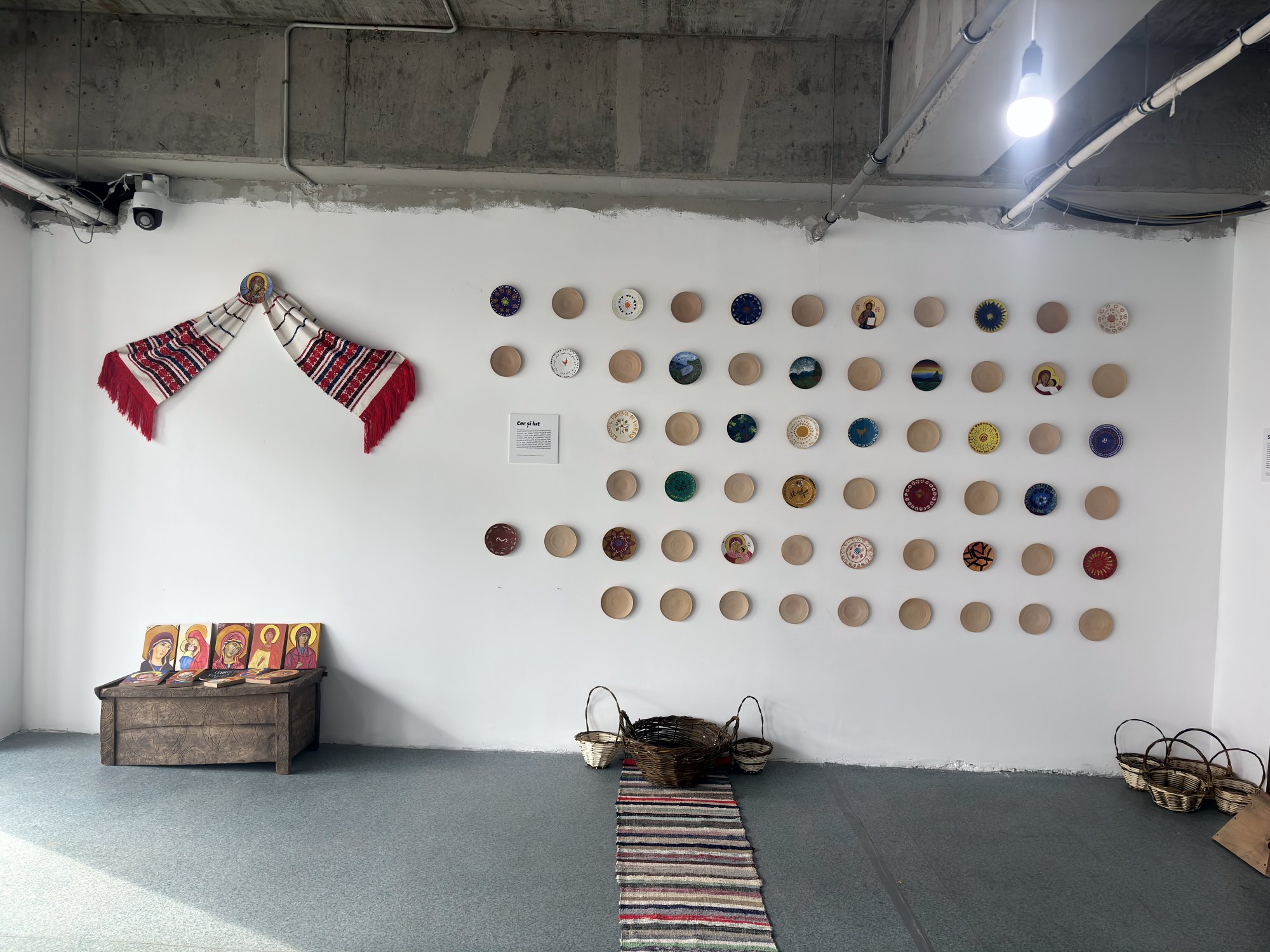
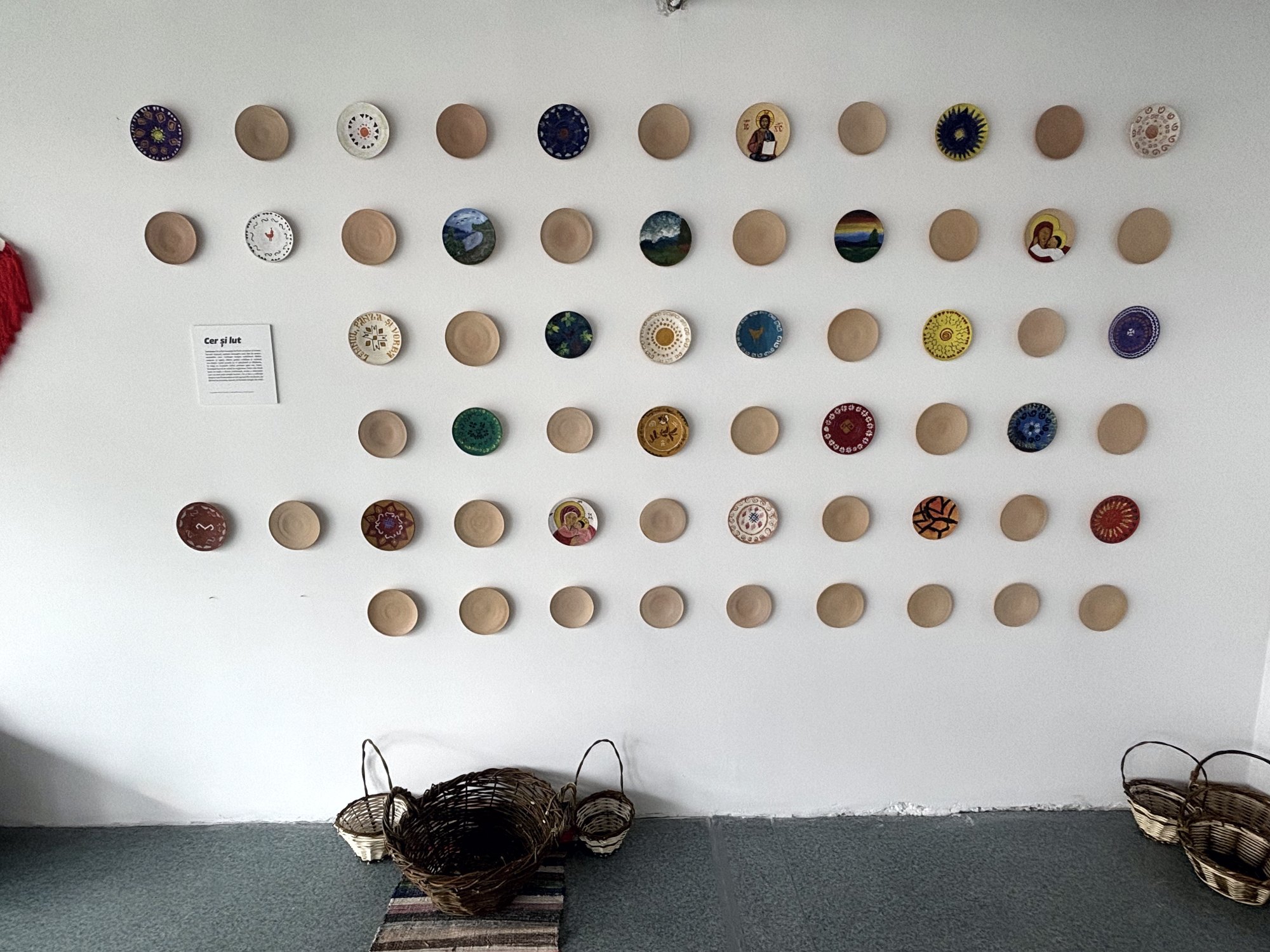
Cer și lut (Sky and Clay)
The installation Cer și lut brings together hand-made ceramic plates and icons, placed on a dowry chest. The ensemble speaks about the balance between matter and spirit, between the everyday gesture and the sign of faith. The clay carries the earth and patience, while the icons lift the gaze towards the sky and turn handwork into prayer. Between the two worlds a luminous silence is born, the silence of objects that are no longer simple things. Cer și lut is a reflection on how beauty takes shape from modesty and how the divine sometimes hides in the simple forms of life.
The objects were made in the workshops with folk craftspeople.

Sub coaja lumii (Under the Bark of the World)
The installation Sub coaja lumii gathers around the work Axis Mundi a group of traditional wooden objects, from gate pillars and distaffs to spoons, relics of a world in which wood was body, shelter and language. Here, wood is more than worked material. It is a living memory and carries the marks of tools, of the human gesture and of the faith that went with it. Sub coaja lumii lies the slow breath of the earth, the vibration of the hands that carved, the sign of the cross hidden in the fibres. Through this installation, the exhibition speaks about the quiet order of the traditional world and the link between spiritual verticality and material roots.
The objects are over 200 years old and belong to the collection of the Museum of Folk Architecture of Gorj in Curtișoara, shown in the exhibition through the Alexandru Ștefulescu County Museum.


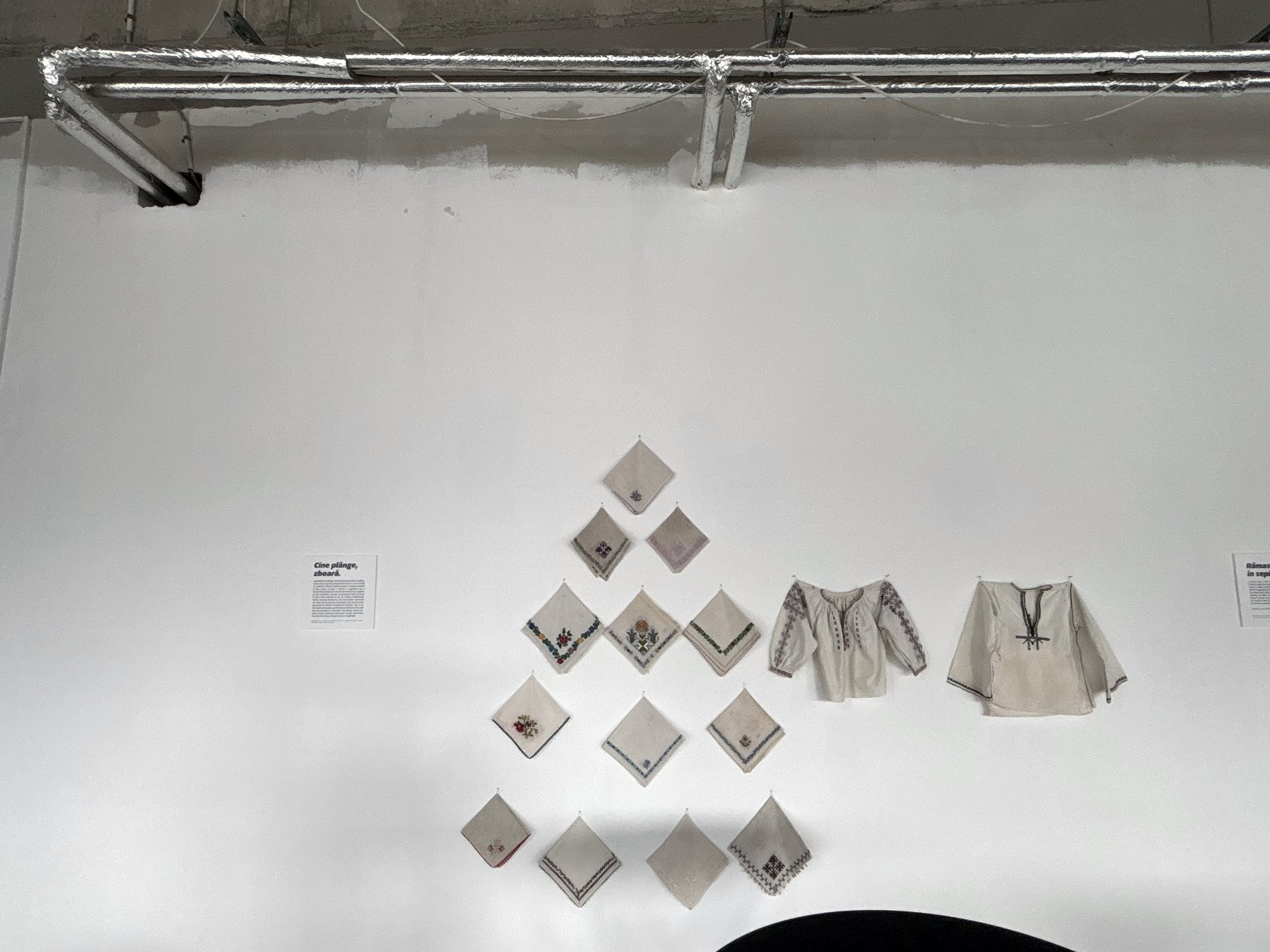
Cine plânge, zboară (Who Cries, Flies)
The installation Cine plânge, zboară brings together traditional hand-sewn handkerchiefs, suspended in the air like a fragile swarm of memories. Each handkerchief carries an emotion embroidered in thread, a gesture, a silence, a prayer or a form of presence that no longer has a body today. Hung on invisible threads, they seem to float between tear and flight, between earth and sky. In traditional culture, the handkerchief went with a woman through the most intimate moments of her life, joys, partings, longing or loss, and became an object of emotional memory. Here they free themselves from the weight of the one who carried them and fly to where pain and grace merge. Cine plânge, zboară speaks about healing through gesture, about the delicacy of handwork and the strength of fragility.
The objects are over 80 years old and belong to the collection of the Grigore Pupăză Ethnographic Museum in Arcani.
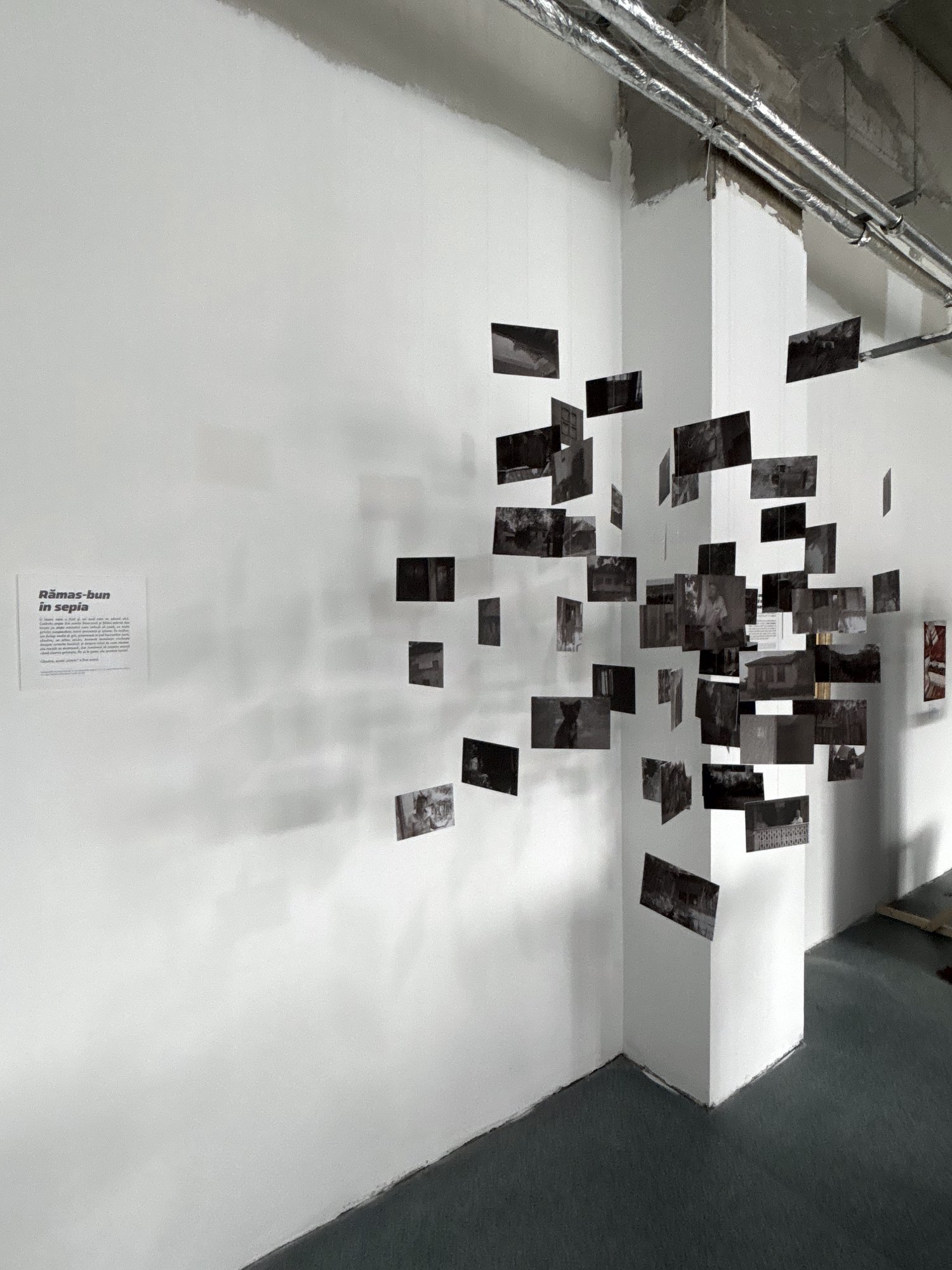
Rămas-bun în sepia (Farewell in Sepia)
A world that was and is no more gathers here. Sepia frames from the villages of Runcurel and Rătez hang from the ceiling like memories that refuse to fall, like glances suspended between presence and oblivion. In the middle, an old and empty wardrobe keeps the echo of the things that were once inside. This installation speaks about the traces of living and about the way rural memory comes apart, yet keeps breathing when someone looks at these places, even in photographs.
Once, this „nothing” was home.
The photographs were taken in July and August 2025 in the villages of Runcurel and Rătez by Daniela Apostol and Laszlo Jozsef.
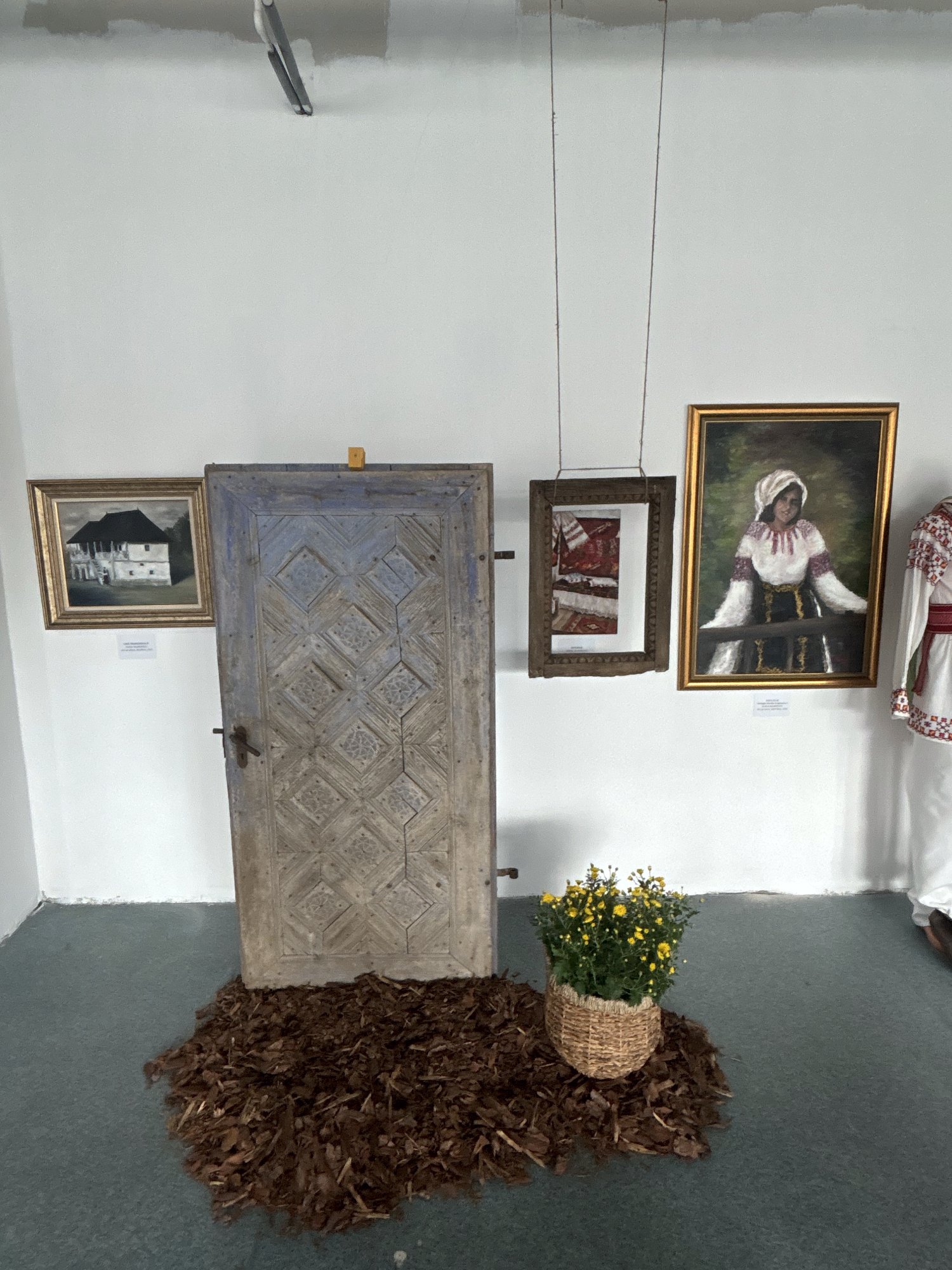
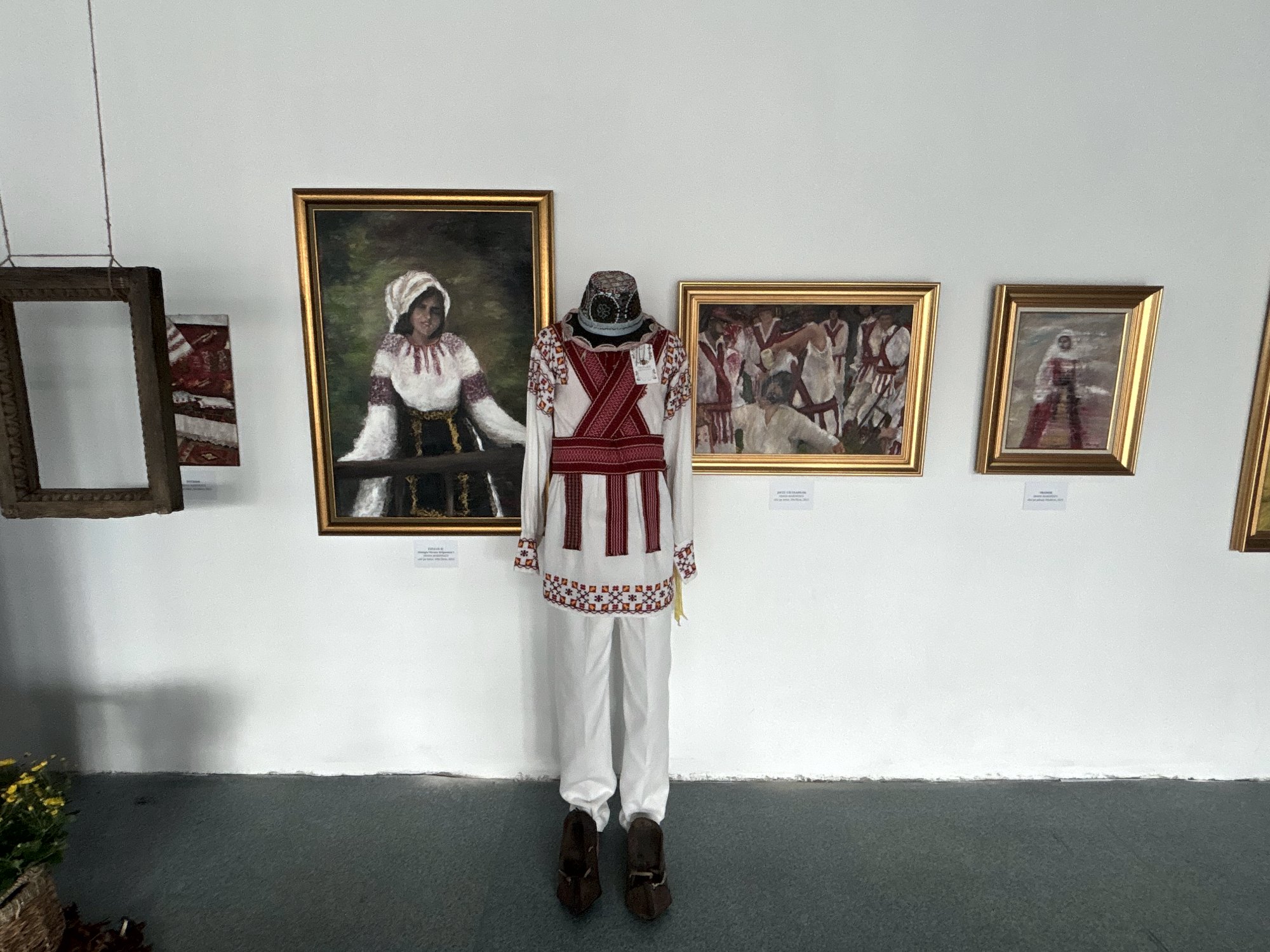
Acolo unde lumina nu uită să se întoarcă (Where the Light Does Not Forget to Return)
La ușa dorului brings together two architectural elements of a traditional Gorj house. The door and the window are both older than 100 years and open the painting collection of Diana Marinescu. The artist made this series from village life, and through her view she reminds us that, even when we are not aware of it, the light still „does not forget” to return to the places we once did not forget either. To the village, the countryside, the traditions and customs made for us to look at each other with warmth.
The series of paintings was made for the exhibition „Lemnul, Pânza și Vorba”. The wooden door, about 150 years old, comes from the collection of the „Grigore Pupăză” Ethnographic Museum in Arcani, and the window, over a century old, belongs to Mitică Moruș. The Călușar costume was made by the craftsman Daniel Ciuncanu (Ciunki).
Din scoarță în scoarță (From Scoarță to Scoarță)
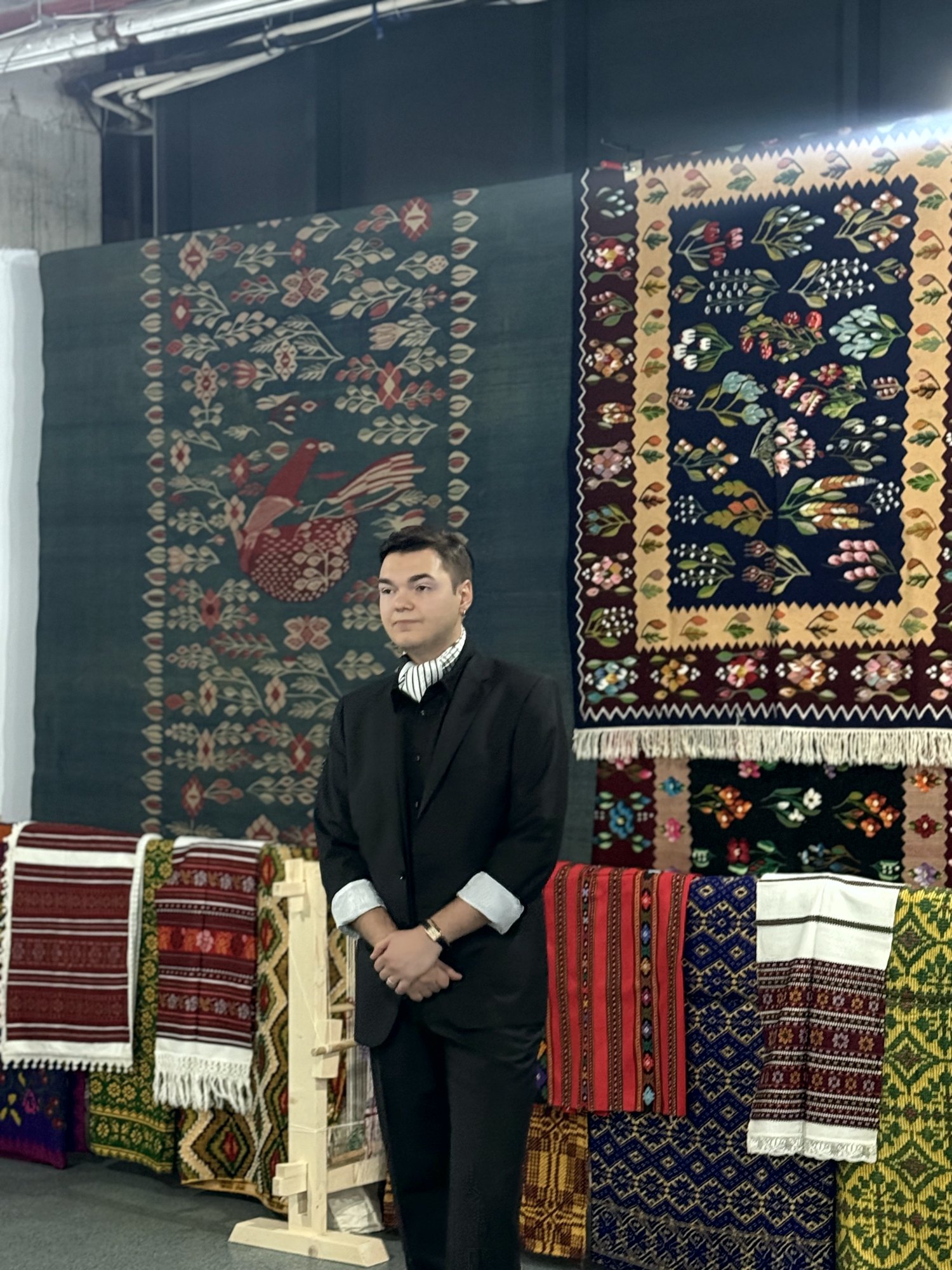
In Gorj, the woven textiles used as wall hangings, carpets, rugs and the like are called scoarțe. The installation Din scoarță în scoarță , made of overlapping traditional carpets, becomes a visual metaphor of the loom, a space where force, repetition and rhythm turn into cultural expression. In Romanian, the word for loom, „război”, also means war. Here it names the mechanism that holds the threads together and makes symbolic continuity and the passing on of collective memory possible, not conflict.
The woven pieces (scoarțe, carpets, wall hangings, towels and tablecloths) come from the collection of the Museum of Folk Architecture of Gorj in Curtișoara and from the collections of the folk craftswomen Mioara Dinoiu (Polovragi), Filomela Tiștere and Claudia Drăghescu (Artizan Tismana) and Angelica Ambruș (Glodeni).
Illo tempore
The installation Illo tempore reinterprets one of the oldest images of Romanian mythology, the girl seated in the silk cradle between the antlers of the stag. In this symbolic construction, the stag becomes the axis of the world, the bearer of light and of the passage between worlds, and the cradle is the threshold where a girl becomes a woman. The suspended veils create the illusion of a slow flight, of floating between earth and sky. The bridal costume evokes the initiatic moment of passage, when the feminine being stands between childhood and maturity.
The title refers to the Latin expression illo tempore („in that time”), a recurring formula in Mircea Eliade’s studies on mythical time and the return to beginnings. In this sense, the installation does not document a ritual. It reconstructs it symbolically and proposes a return to the original time.
Veils made of borangic (natural silk from silkworms), fine cotton and thin linen. They date from 1920 to 1980 and belong to the collection of the Museum of Folk Architecture of Gorj in Curtișoara.
Press and links
- Docuart, Memoria satelor care dispar, 300 de piese autentice într-o expoziție produsă de Docuart
- Modernism.ro, Memoria satelor care dispar, 300 de piese autentice
- Centrul Constantin Brâncuși, Expoziția Lemnul, Pânza și Vorba, o călătorie în patrimoniul imaterial din Gorj
- Agerpres, Gustul ca patrimoniu, celebrat la finalul expoziției Lemnul, Pânza și Vorba
- Gorjeanul, Expoziția Lemnul, pânza și vorba, inaugurată astăzi la sediul PavilionArt360
- Gorjeanul, Expoziția Lemnul, Pânza și Vorba, deschisă până la sfârșitul lunii octombrie 2025
- Știrea Verde, Asociația Docuart reînvie satul gorjenesc prin expoziția Lemnul, Pânza și Vorba
Artists: Diana Marinescu, Roxana Donaldson
Organiser: Asociația Docuart
Co-financed by: Administrația Fondului Cultural Național
Partners: WIN Gallery, Primăria Municipiului Târgu Jiu, Centrul Constantin Brâncuși, Muzeul de Istorie și Arheologie Alexandru Ștefulescu, Muzeul de Etnografie și Artă Populară Curtișoara, Muzeul Etnografic Grigore Pupăză Arcani, Muzeul Satului Lelești, Școala Populară de Arte Constantin Brâncuși, Universitatea Constantin Brâncuși, Institutul de Cercetare, Dezvoltare și Inovare, Liceul de Arte Constantin Brăiloiu
Lasă un comentariu